

serratus anterior
- noun
- /ˈsɛrətəs ænˈtɪrɪər/
- Specialized
- The serratus anterior plays a vital role in stabilizing the shoulder blade during movement.
Examples
-
Weakness in the serratus anterior can cause winging of the scapula.
-
The serratus anterior plays a crucial role in shoulder movement.
-
Proper push-up technique engages the serratus anterior to support the shoulders.
-
I felt pain in my serratus anterior after the workout.
-
The serratus anterior is important for efficiently elevating the rib cage during breathing.
-
To properly engage the serratus anterior, make sure to rotate your scapula during exercises.
-
Physical therapists often emphasize the role of the serratus anterior in stabilizing the shoulder blade.
Synonyms
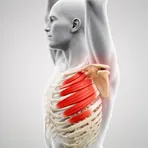
A muscle at the side of the chest that lifts the shoulder blade and helps raise the ribs when breathing

A muscle that helps turn the shoulder blade and lift the ribs
Surface Forms
Morphology
The compound is directly built from 'serratus' (a saw-toothed muscle) and 'anterior' (toward the front), so its meaning as the front/lateral saw-toothed chest muscle is transparently derivable from the constituents. Although it's a technical anatomical term, the naming is fully compositional and mirrors cross-linguistic anatomical patterns, so a learner who knows both constituent meanings will understand the MWE.
Etymology
Serratus anterior comes from Latin: serratus means 'saw-like' because the muscle has finger-like edges along the ribs, and anterior means 'front' because it sits on the front of the chest. So the name gives a clear picture — a saw-like muscle at the front that helps move and support the shoulder blade.

