
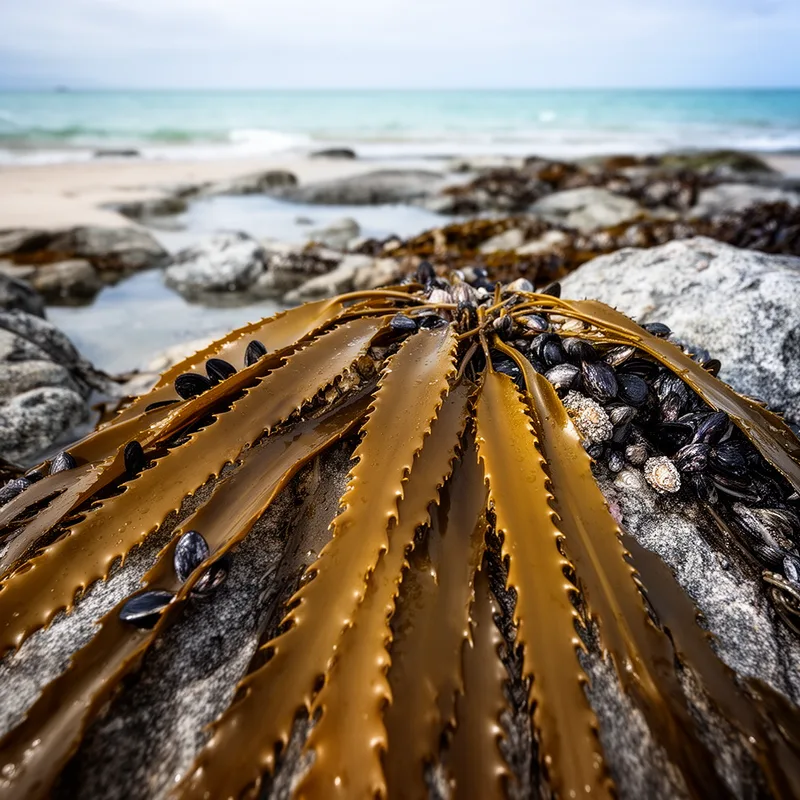
serrated wrack
- noun
- Specialized
- You can often find mussels clinging to serrated wrack at low tide.
Examples
-
The shoreline was covered in serrated wrack after the storm.
-
Marine biologists study serrated wrack to understand coastal ecosystems.
-
I found some serrated wrack on the beach yesterday.
-
The serrated wrack grows abundantly along the coast.
-
The tide brought in a variety of seaweeds, including serrated wrack, which is easily recognizable by its sharp edges.
-
At the rocky cove, we found serrated wrack clinging to the stones, its saw-toothed leaves waving in the water.
-
While exploring the shoreline, I noticed patches of serrated wrack that added texture to the underwater landscape.
Synonyms


 1
9.0
1
9.0
A rough brown seaweed that grows on rocks at low tide
 1
9.9
1
9.9
Seaweed and other water plants washed up on the shore

A brown seaweed with jagged edges that grows on rocky seashores in the North Atlantic

Dead seaweed and other sea plants washed up on the shore
Surface Forms
Morphology
The meaning 'a seaweed with saw-toothed edges' is directly and compositionally derived from 'serrated' (saw-toothed) + 'wrack' (seaweed). Adjective + noun constructions describing a visible physical property are cross-linguistically common and follow straightforward compositional rules, so a B1 learner who knows both constituents would readily understand this phrase.
Etymology
Serrated wrack gets its name from the plant's saw-like edge and from the old word wrack, which meant 'seaweed that washes up on the shore', so the name simply describes a brown seaweed with saw-toothed edges found on rocky beaches.