
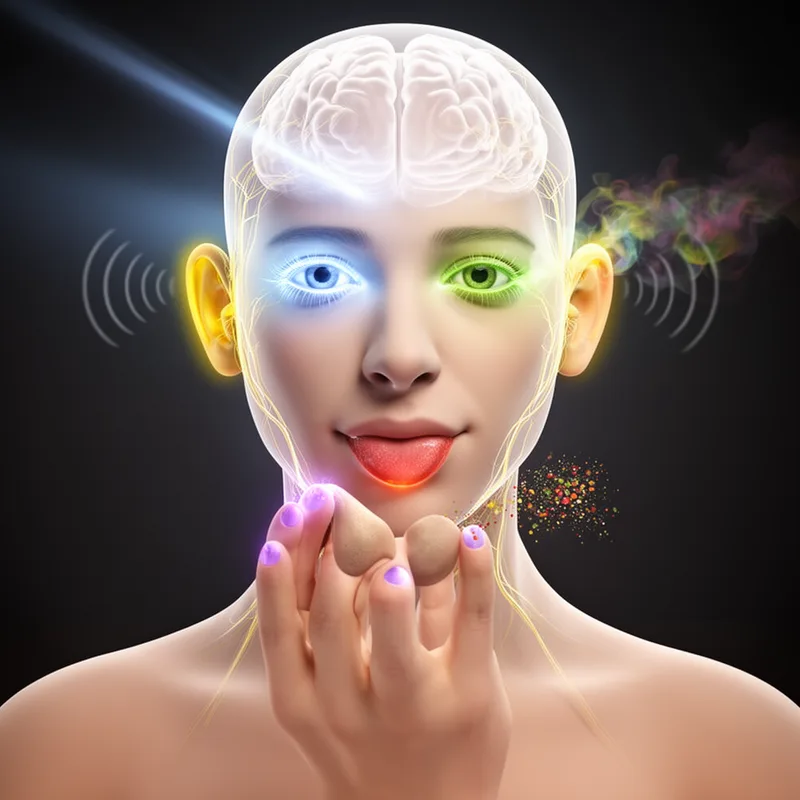
sense organ
 1
3.5
1
3.5

- noun
- /sɛns ˈɔrɡən/
- Animals often rely on their sense organs to navigate their environment and find food.
Loading YouTube…
Watch on YouTubeBut this life will not feel enhanced by perceiving more through the five sense organs.
- But this life will not feel enhanced by perceiving more through the five sense organs.
- It, it reacts not following the apprehension of reason, but the apprehension of the sensitive parts that is our our sense organs, right?
Examples
-
The doctors examined the patient's sense organs to determine the cause of her hearing loss.
-
Batteries of touch-sensitive hairs around the eyes and ears inform them about their surroundings, as does a remarkable sense of smell and a moist nose, which is joined by a groove to a special sense organ in the roof of the mouth.
Academic text (1995) -
By reading the animal's feet, its eyes, and other sense organs, the zoologist should be able to tell how it found its food.
Academic text (1995) -
All your sense organs are outward bound because they are survival instruments.
-
A typical neuron would collect information either from other neurons or from sense organs through its dendrites.
-
Autarchoglossans use their tongues to pick up heavy, non-airborne chemicals and deliver them to the vomeronasal organ, a sense organ in the roof of the mouth.
Academic text (2006) -
Descartes' view of scientific knowledge is reductionist, to the extent that, say, the perception of red is merely a subjective indication of a property existing objectively in reality which we are able to detect with our sense organs.
Blog text (28) -
These authors all reported similar pathologies: deposition of various amounts of fibrous tissue and new bone in the inner ear spaces and degeneration of the organ of Corti and vestibular sense organs.
Academic text (1999) -
The human body has five main sense organs that detect different types of sensations.
Synonyms
 1
5.8
1
5.8
A body part that senses touch, light, or sound and sends signals to the brain
How Specialized
- Specialized
1
5.8
 1
3.5
1
3.5
Surface Forms
Morphology
The meaning is directly compositional: combining 'sense' (a faculty for sensing) with 'organ' (a part that performs a function) yields 'an organ for sensing', which a B1 learner who knows both words can readily infer. The technical extension to artificial sensors in robotics is a predictable analogy of biological sense organs and is cross-linguistically common, so the expression is transparent.
Etymology
The term sense organ comes from the words sense, meaning 'to feel or notice', and organ, meaning a body part that does a job. It creates the image of a body 'tool' that picks up sight, sound, touch, taste, or smell, so it means the parts that let us sense the world.