
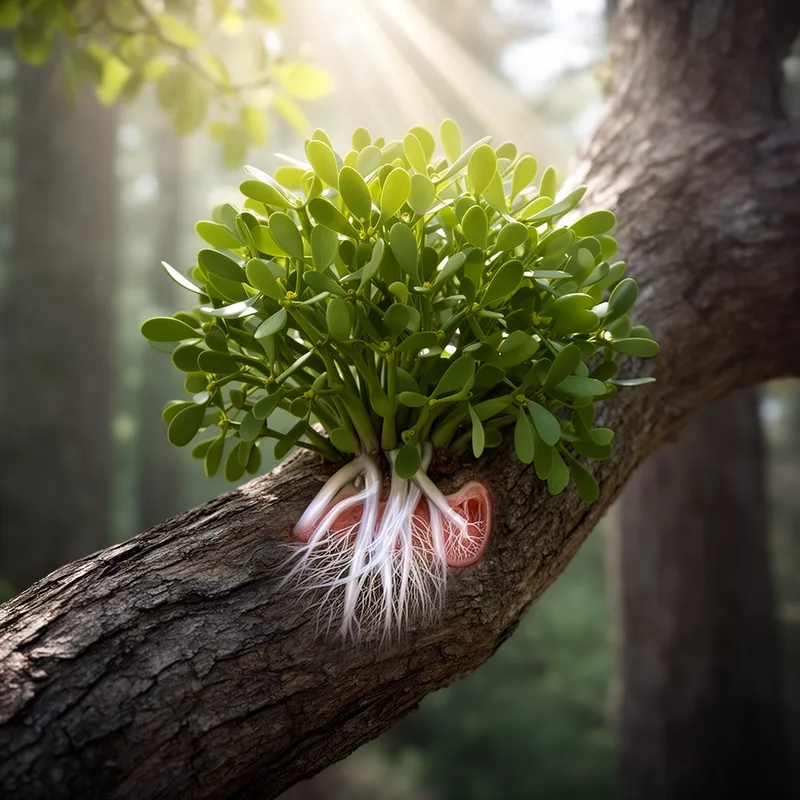
semiparasite
- noun
- /ˌsɛmiˈpærəˌsaɪt/
- Specialized
- The mistletoe is a well-known semiparasite that still performs some photosynthesis.
Examples
-
Unlike true parasites, a semiparasite can produce its own food through sunlight.
-
Scientists studied the relationship between the host tree and the semiparasite growing on its branches.
-
The semiparasite thrives in the forest.
-
Some semiparasites can photosynthesize effectively.
-
The mistletoe is a well-known semiparasite that still performs some photosynthesis.
-
Scientists studied the relationship between the host tree and the semiparasite growing on its branches.
-
Unlike true parasites, a semiparasite can produce its own food through sunlight.
Synonyms
A plant that makes some food from sunlight but takes water and minerals from another plant
Antonyms


How Parasitic
- Specialized

 1
5.3

- Specialized
Surface Forms
Morphology
Etymology
Semiparasite comes from semi- ('half'), the same semi- in semicircle, and parasite ('one who lives off another'). So a semiparasite is 'half' a parasite: it takes some food from another plant but still makes its own food using sunlight.