
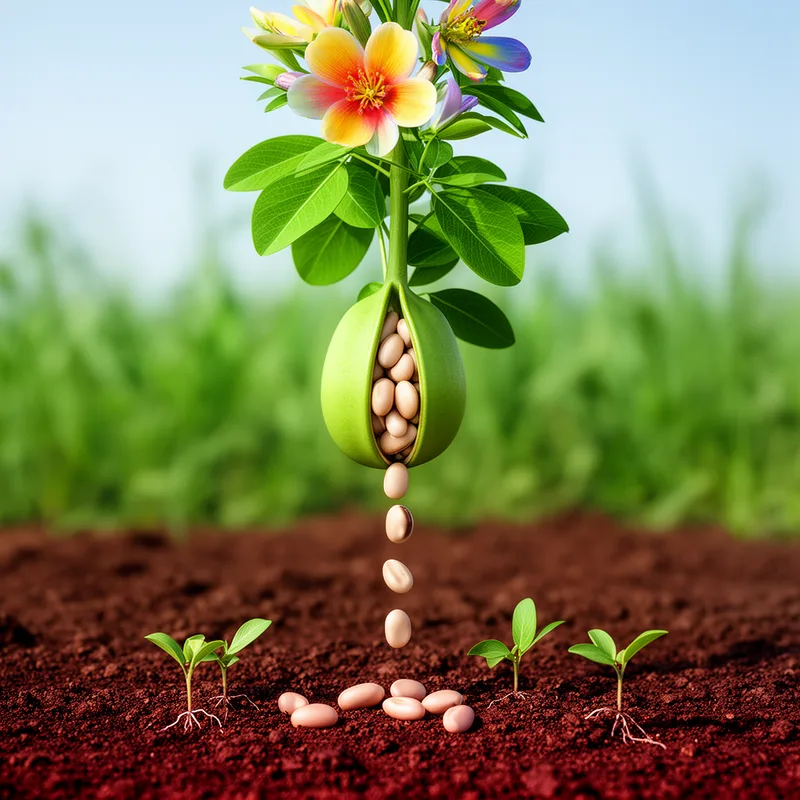
seed plant


 1
3.2
1
3.2
- noun
- /siːd plænt/
- We only see trees among seed plants, which consist of two groups, gymnosperms and angiosperms.
- seed plant lineage
Examples
-
Govaerts R. 2001. How many species of seed plants are there? Taxon 50: 1085-1090.
Academic text (2012) -
Shown are 10 classes of green algae and the single monophyletic lineage representing all embryophyte plants (bryophytes, vascular plants, seed plants, flowering plants).
Academic text (2008) -
Comparing stages of allopolypioid formation in homosporous pteridophytes with similar aspects of seed plants.
Academic text (2002) -
Biologists have been intrigued by homosporous plants because they are genetically distinct from seed plants.
Academic text (2002) -
But these "evolutionary experiments" in the heterosporous way of life, whose ancestors are homosporous, did not result in the extraordinary burst of diversification seen among the seed plants, and they are not the focus of this review.
Academic text (2002) -
In most cases, surveys of seed plants have upheld this assumption (but see Elisens and Crawford 1988), and thus have led to the application of isozyme evidence in determining ploidy levels in plants.
Academic text (2002) -
Although the well-studied seed plants find their closest relatives (sister group) among these species (Pryer et al. 2001), called homosporous pteridophytes, genetic aspects of homosporous plants have not been studied extensively.
Academic text (2002) -
Under the oaks grew camas (Camassia quamash), wapato (Sagittaria latifolia), wild onions, and other bulb, root, and seed plants.
Blog text (5) -
The ecosystem relies heavily on the contributions of seed plants for oxygen and food sources.
-
Most of the plants in our garden are seed plants, providing beauty and shade.
Synonyms
A plant that makes seeds to grow new plants, not spores
A plant that makes seeds instead of spores
Surface Forms
Morphology
The meaning 'a plant that reproduces by producing seeds' is directly and compositionally derived from combining 'seed' (a part that can sprout) with 'plant' (a photosynthetic organism); the compound names a type of plant characterized by seeds. This is a common noun–noun compounding pattern found across languages and is transparently interpretable by a B1 learner who knows both constituents.
Etymology
The compound noun seed plant comes from the clear image of a plant that makes and drops seeds to start new plants. So, 'seed plant' means a plant that reproduces by producing seeds rather than by spores.