

sea serpent
 3
9.5
3
9.5

- noun
- /siː ˈsɜːrpənt/
- Literature
- Many ancient cultures believed in a sea serpent that would emerge from the ocean during storms to attack passing vessels.
Loading YouTube…
Watch on YouTubeAs per usual, the thought of a huge sea serpent or heck, the Loch Ness Monster, Why not?
- As per usual, the thought of a huge sea serpent or heck, the Loch Ness Monster, Why not?
Examples
-
It showed a great fish or sea serpent curving down to swallow a rival's tail.
-
The legend tells of a giant sea serpent that was said to guard treasures buried beneath the waves.
-
Looks like a sea serpent.
-
More photos of the sea serpent here.
Blog text (13) -
Or get eaten by a sea serpent.
-
Tales of sea serpents and worse.
-
It's a mythical sea serpent.
-
She was to be sacrificed to a sea serpent.
-
The myth of Columbus includes illustrations of sea serpents crawling at the shelf of the end of the world.
Fiction book (1991) -
In folklore, sailors often spoke of a sea serpent lurking in the depths, ready to drag ships underwater.
Synonyms
 72
6.5
72
6.5
A large snake with scales that often appears in myths and stories
 10
9.9
10
9.9
A large sea monster mentioned in the Bible that shows great danger
 10
9.9
10
9.9
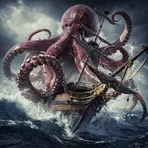
A huge sea monster like a giant squid that attacks ships


 1
9.9
1
9.9
A legendary snake-like creature in South and Southeast Asian stories
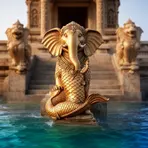
A sea creature from Hindu and Buddhist stories with parts of different animals
How Powerful
- Literature
10
9.9

- Offensive
395
2.5
- Literature
3
9.5
15
1.1
Surface Forms
Morphology
The meaning 'a large marine creature resembling a snake or dragon' is directly compositional from 'sea' (marine) + 'serpent' (snake-like creature), so a learner who knows both words can infer it as a serpent that lives in the sea. This compound follows a common cross-linguistic pattern (noun+noun indicating type/location), making it immediately comprehensible to a B1 learner.
Etymology
Sea serpent comes from sailors who saw long, snake-like shapes in the sea. They called those shapes serpents, so 'sea serpent' now means 'a large, snake-like sea monster' in stories.