
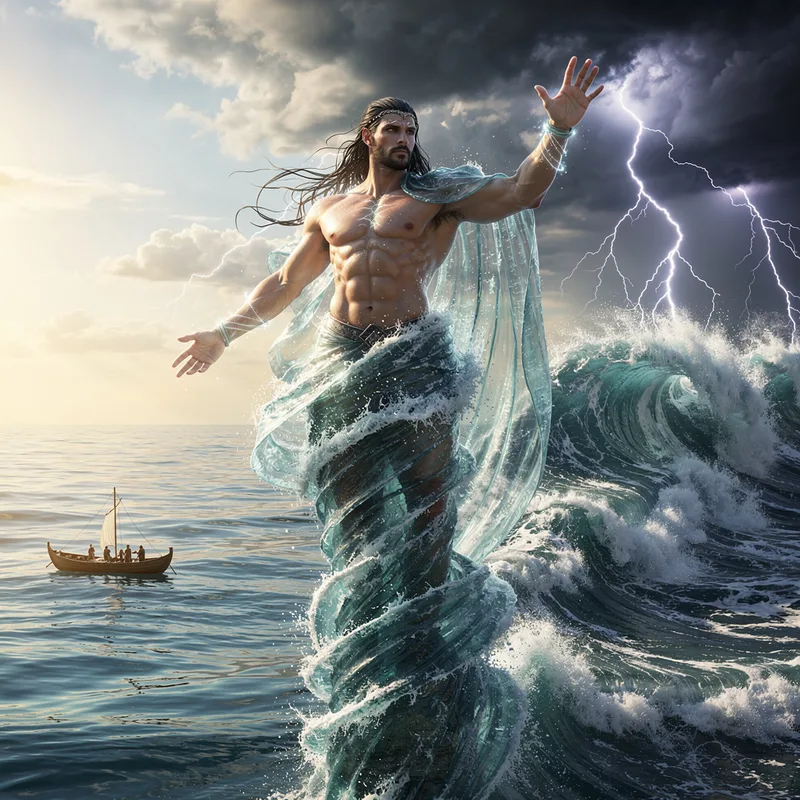
sea god
 1
8.1
1
8.1

- noun
- /siː ɡɒd/
- Literature
- Sailors prayed to the sea god for safe passage across the treacherous waters.
- sea god Poseidon
- son of the sea god
Loading YouTube…
Watch on YouTubeOur girl, for reasons we learn about, finds herself in the sea God's realm, and it's just great.
- Our girl, for reasons we learn about, finds herself in the sea God's realm, and it's just great.
Examples
-
Our girl, for reasons we learn about, finds herself in the sea God's realm, and it's just great.
-
He was a sea god in ancient Greek mythology.
Academic text (2007) -
They believe if the sea god wishes to take you, resistance is not only useless but impious as well.
Fiction book (1991) -
But anyway, Poseidon, the sea god, punished Cassiopeia by placing her in the heavens upside down in her throne, stuck for eternity with her skirt around her shoulders, and all the blood rushing to her head.
-
You're right, you haven't disproven Poseidon and Ahura Mazda, so you will have to worship the Greek sea god and the Persian god.
Blog text (8) -
In ancient myths, the sea god was often depicted as a powerful figure who controlled the waves and storms.
-
Legends tell of a sea god who could calm the tempestuous sea with a mere gesture.
Synonyms
 28
6.3
28
6.3
A Greek god who rules the sea and causes earthquakes, often shown with horses
 24
5.0
24
5.0
A Roman god who rules the sea
 14
9.9
14
9.9
A sea god who can change his shape at will


 1
9.9
1
9.9
A sea god from old Irish stories, son of Ler, linked with magical islands, mist, and sailors

A sea spirit in Greek myth and father of many sea gods

An ancient Greek god of the sea, father of Nereus

A Greek god who is the great river said to flow around the world
How Powerful
- Literature
1
8.1

- Literature
1
9.9
- Literature
- Literature
1
9.5
Surface Forms
Morphology
The meaning 'a deity who governs or personifies the sea' is directly derived from combining 'sea' (body of saltwater) with 'god' (a worshipped supernatural being), since the modifier 'sea' specifies the domain of the god. This noun+noun compositional pattern is common across languages, so an average B1 learner who knows both words would readily infer the MWE's meaning.
Etymology
The compound noun sea god joins sea and god to make a clear picture: a 'god' who rules the 'sea', like Poseidon, whom sailors asked for help or feared. That's why it means 'a god believed to rule the sea'.