
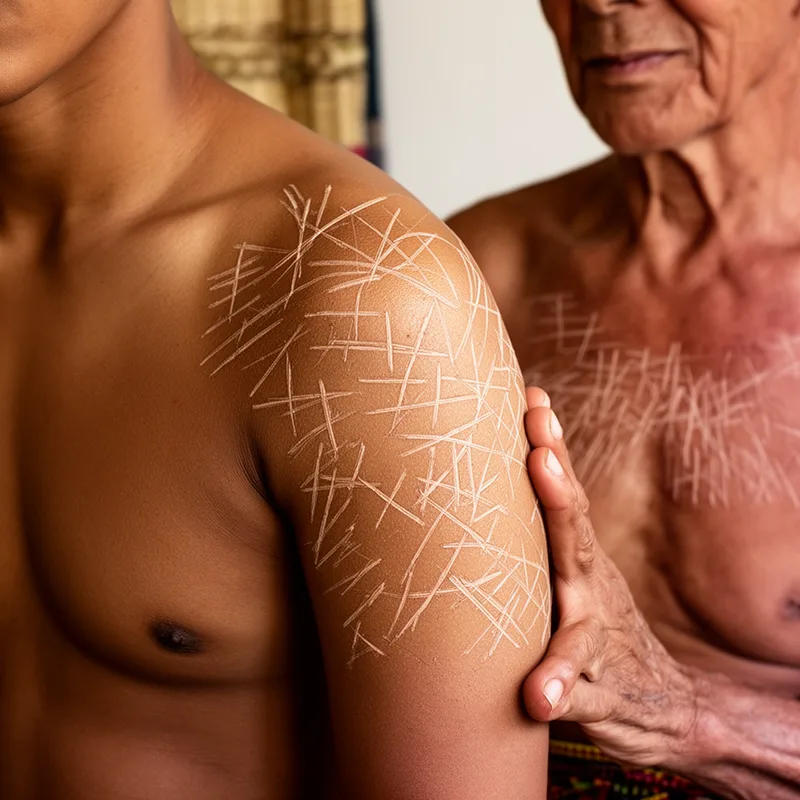
scarification


 1
9.6
1
9.6
- noun
- /ˌskærɪfɪˈkeɪʃən/
- In certain cultures, scarification is performed as a rite of passage to signify adulthood.
- scarification marks
- scarification pattern
- body scarification
Examples
-
The abdominal region has been accentuated by the prominent umbilicus, surrounded by elaborate scarification patterns.
Academic text (2008) -
As tactile registers, scarification signifies the cultivation of the body for adulthood, marriage, and birth.
Academic text (2007) -
And, he was covered with scarification on his face.
-
Motifs were not drawn from female scarification on the face, back, and body front, and male scarification did not exist.
Academic text (2007) -
Every inch of his face is covered with ritual scarification patterns and Maori-like tribal tattoos.
Fiction book (1998) -
The female figure's studded cap, chiseled teeth, and scarification indicate aristocratic status.
Academic text (2003) -
The traditional scarifications are usually engraved, cut away, incrusted, or carved in relief.
Academic text (2000) -
The caryatid figure depicts a female ancestor with an elegant coiffure and intricate body scarification.
Academic text (1999) -
Traditionally, Senufo women's scarification consists of four sets of three scars radiating from the navel which are called "male-female twins."
Academic text (2008) -
Many indigenous communities practice scarification to display their tribal identity and heritage.
Antonyms

How Permanent

Surface Forms
Morphology
Etymology
Scarification comes from scar, a mark left by a cut, and -fication meaning 'making'. A helpful way to remember the cultural sense is that people make small cuts on purpose to create a lasting 'mark' for decoration or identity.