
saccharin
 2
6.3
2
6.3

- noun
- /ˈsækəˌrɪn/
- For the control animals, one of the bottles contained water and the other a solution of water with 0.2% saccharin.
- saccharin and water
- intake of saccharin
Loading YouTube…
Watch on YouTubeSo we know that saccharin and sucralose also cause spikes in your blood sugar.
- So we know that saccharin and sucralose also cause spikes in your blood sugar.
Examples
-
My doctor told me to cut out all sugar and use saccharin as a substitute.
-
A 2% saccharin solution was used as the CS.
Academic text (1993) -
For one week, this group consumed the maximum acceptable daily intake of saccharin.
Academic text (2014) -
So we know that saccharin and sucralose also cause spikes in your blood sugar.
-
First, mice were provided with water containing artificial sweetener (saccharin) or sugar water.
Academic text (2014) -
Consider, for example, the immediate function of behaviors reinforced by saccharin, or behaviors intended to fulfill explicit desires for sweet foods containing saccharin.
Academic text (2001) -
Among all the methods that are used to measure nasal transit time, the saccharin test has two major advantages: it is simple to perform and it does not require any sophisticated equipment.
Academic text (1999) -
Sodium saccharin (Sigma Chemical Co., St. Louis, MO) was added to the ethanol solutions to achieve 0.2% (w/v).
Academic text (2016) -
Later, a simpler and noninvasive method was perfected in which a particle of saccharin is deposited on the nasal mucosa while an examiner notes the length of time that passes before the subject reports the first taste of sweetness.
Academic text (1999) -
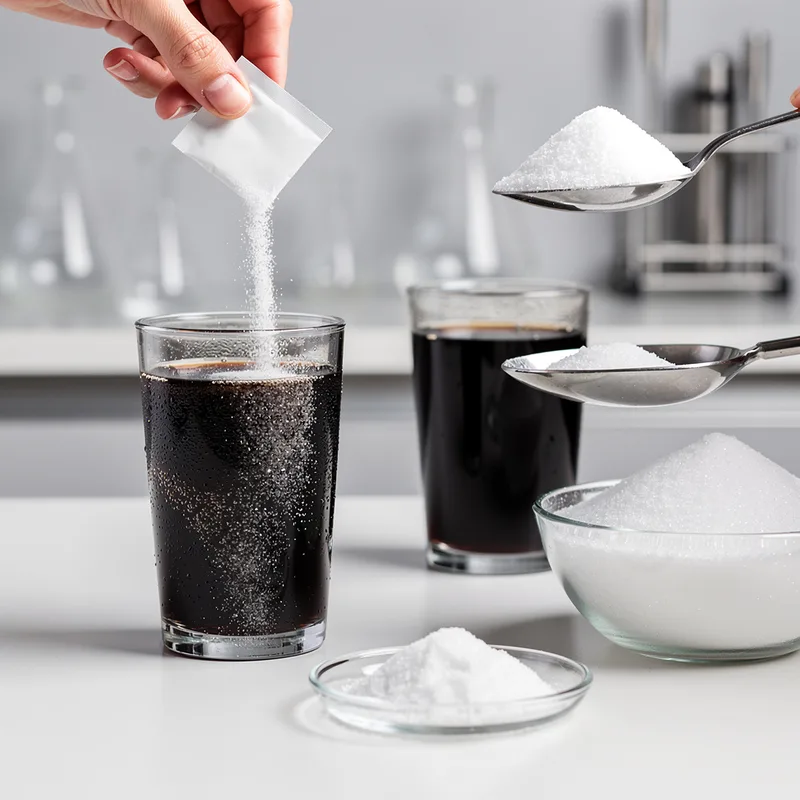
Many people prefer saccharin because it has no calories and is much sweeter than sugar.
Synonyms
 30
2.0
30
2.0
A substance added to food or drink to make it taste sweeter

Something added to food or drink to make it sweeter
How Sweet

Surface Forms
Morphology
saccharin = sacchar + in
Formed from the combining form 'sacchar-' (sugar) + the chemical suffix '-in'; the combining form is not a productive or recognizable English base for most learners, so the modern meaning 'artificial sweetener' is not directly inferable.
Etymology
Saccharin comes from the old root sacchar- meaning 'sugar', the same root behind the English word sugar. It was named because it tastes like sugar even though it is an artificial sweetener, so think 'sugar-like' to remember its meaning.