

to round out
- phrasal verb
- /raʊnd aʊt/
- To define your face shape, contour the bridge of your nose and round out the edges of your cheeks.
Examples
-
That seems a chronic Soviet disorder: nothing ever is quite rounded out, including their Five-Year plans.
Academic text (2017) -
You should round out the corners of the table to prevent any accidents.
-
For the head, yes, go ahead and start to round out your head and create the head shape.
-
The arch I actually like to round out for some reason, I don't know why, I like rounded.
-
To create a smooth surface, begin to round out the edges of the block of wood.
-
When decorating the cake, be sure to round out the sides for a polished look.
Synonyms

 76
2.1
76
2.1

Make something have a curved shape
 14
2.8
14
2.8
To become or make something fuller by adding more
 1
4.5
1
4.5
To make a pillow or cushion fuller by fluffing it
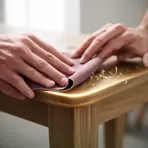
To make a sharp edge or corner smooth and curved
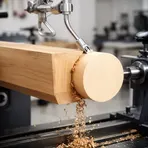
To change an object so it becomes round
Antonyms
How Round

Surface Forms
Morphology
round + out
The meaning 'to make something more rounded' is directly compositional from 'round' (to make or be circular/rounded) plus the particle 'out' (often meaning to make something complete or fully so). Even if one sense of 'round' is numeric, the shape-related sense is common at B1 and the verb+out pattern is a regular, cross-linguistically familiar composition, so learners who know the constituents can infer the meaning.
Etymology
The verb round out comes from the literal act of smoothing a sharp edge until it becomes curved, like sanding a table corner or the edge of a stone. That's why it can mean 'to make something more rounded in shape'.