

rotary press
- noun
- /ˈroʊtəri prɛs/
- Specialized
- Many modern books are printed using a rotary press due to its efficiency in handling large volumes.
Examples
-
In the age of powered rotary presses, linotype machines, and machine-made paper, he insisted on using hand presses, manual typesetting, and handmade linen paper.
Academic text (2017) -
The newspaper switched to a rotary press to increase its production speed and reduce costs.
-
Current printing processes are no longer planographic and performed with a platen press, but make use of the high-throughput capabilities of cylindrical rotary presses.
Academic text (2001) -
With a rotary press, the company can print thousands of copies in just a few hours.
Synonyms
 141
4.1
141
4.1

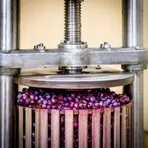
A machine that uses pressure to shape, cut, or squeeze things
 23
3.1
23
3.1
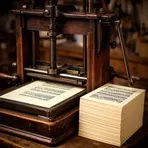
A machine that makes many copies of pages with text or pictures on paper
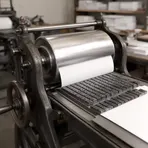
A printing machine where a cylinder rolls paper over a flat bed of letters to copy text
Antonyms

- Specialized
A machine that prints by pressing paper onto a flat surface with a roller
How Fast
- Specialized

- Specialized
- Specialized
- Archaic
Surface Forms
Morphology
The meaning is directly compositional: 'rotary' (operating by rotation) + 'press' (a mechanical device that exerts pressure) yields a press that works by rotation. This adjective+noun formation and the inference of a high-speed machine are cross-linguistically common and predictable, so a B1 learner who knows both words would understand the MWE.
Etymology
Rotary press comes from the machine's two parts: rotary (a round drum that turns) and press (a machine that presses ink onto paper). Because the drum turns as it prints, the machine can make many copies very quickly, so the term means 'a printing machine for fast, large-scale printing'.