

rope burn
 4
3.9
4
3.9

- noun
- /roʊp bɜrn/
- After climbing the mountain, he noticed a painful rope burn on his wrist.
- rope burns on her wrist
- get rope burn
Examples
-
Ensign Izquierdos brought the first aid kit and checked the rope burn on her right arm.
Fiction book (1999) -
And in rope-climbing, they all got rope burn.
-
I think I have a rope burn.
Fiction book (1999) -
He would have taken more care not to leave the rope burns on her wrists.
-
"I expected more of a splinter or scrape than what looked like rope burns."
Blog text (34) -
Maryann looked up and nodded; she lifted the sleeve of her dress and showed him rope burns.
Fiction book (1997) -
A little more than two weeks later, Aaron returned home, his hands blistered, his knuckles raw, and a rope burn on his right wrist.
Academic text (2001) -
He had rope burns.
Academic text (2001) -
"I held up my hands, pushed back the draping sleeves of my paisley smock top, and revealed the rope burns on my wrists.
Blog text (3) -
She applied ointment to the rope burn that marked her arm from the climbing session.
Synonyms

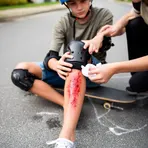
How Severe


Surface Forms
Morphology
The meaning 'an abrasion caused by friction with a rope' is directly and compositionally derived from 'rope' (the cause/instrument) + 'burn' (an injury), so the referent is predictable from the parts. This straightforward noun-noun compound follows common cross-linguistic patterns of cause+injury and would be readily understood by a B1 learner who knows both constituents.
Etymology
Rope burn comes from a simple, painful image: a fast-moving rope rubbing a person's 'skin' so hard it feels like a burn. That's why the phrase means 'an injury caused by rubbing with a rope'.