
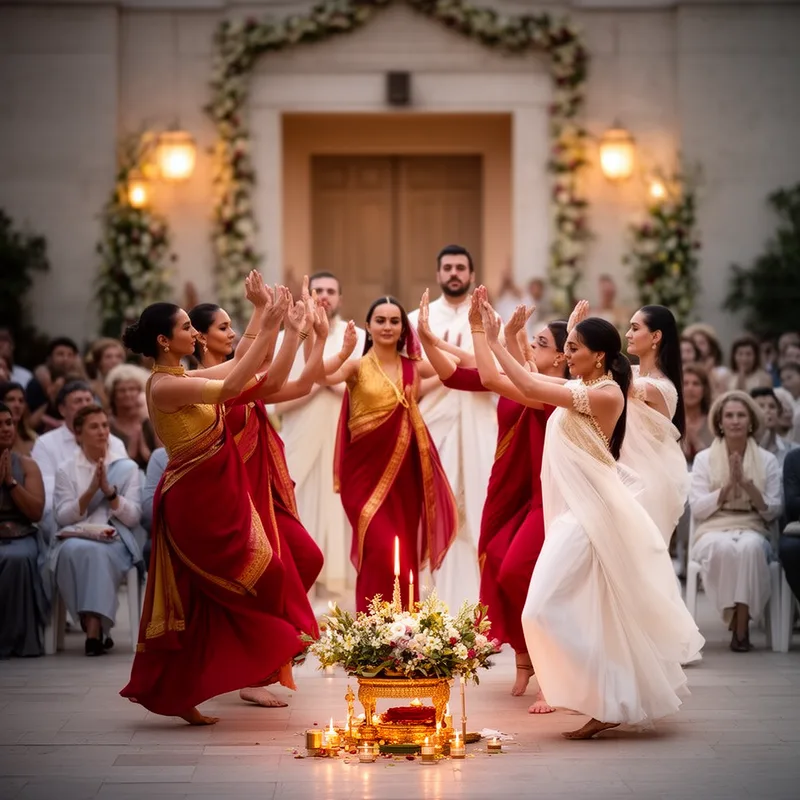
ritual dancing
- noun
- During the festival, locals engage in ritual dancing to celebrate the harvest and seek blessings.
Examples
-
The wedding ritual dancing, themes in song verses, and dispute commentaries reveal how nobles have very nearly defined themselves as a separate, quasi-ethnic group within Tuareg society.
Academic text (1992) -
All her ritual dancing was accomplished in this one motionless space, in the immovable, dense air.
Fiction book (1998) -
During the ritual dancing, the oldest woman in the community sings an erotic song, while the young women and men observe its rhythm by dancing in imitation of reindeer.
Academic text (2000) -
The community gathered around the fire for the traditional ritual dancing to honor their ancestors.
-
After sunset, the villagers began their ritual dancing, marking the start of the sacred ceremony.
Synonyms
 1
5.8
1
5.8

A dance performed during a religious or traditional ceremony


 1
4.2
1
4.2
A dance done during a religious or ritual ceremony to show respect
How Ceremonial

Surface Forms
Morphology
The meaning 'a dance performed as part of a religious or ceremonial ritual' is directly and compositionally derived from 'ritual' (ceremonial actions) + 'dancing' (engaging in rhythmic movement). This straightforward noun-noun/compound pattern is common cross-linguistically and follows regular English compounding rules, so a B1 learner who knows both constituents will readily infer the MWE meaning.
Etymology
Ritual dancing shows a clear picture: people moving together in a ritual, a circle of dancing people keeping a steady beat to honour a spirit or to mark big life events like weddings or funerals. That's why it means 'a dance performed as part of a religious or ceremonial ritual'.