

right prism
- noun
- /raɪt ˈprɪzəm/
- Specialized
- The volume of a right prism can be calculated by multiplying the area of the base by the height.
Examples
-
Students constructed a model of a right prism using cardboard and glue for their geometry project.
-
In a right prism, all the lateral faces are rectangles perpendicular to the bases.
-
A right prism has rectangular sides.
-
The right prism is a common shape in geometry.
-
In a right prism, all the lateral faces are rectangles perpendicular to the bases.
-
Students constructed a model of a right prism using cardboard and glue for their geometry project.
-
The volume of a right prism can be calculated by multiplying the area of the base by the height.
Synonyms
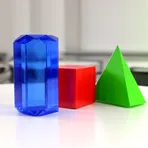
A solid with two equal regular flat shapes as ends and rectangular sides
Surface Forms
Morphology
The meaning is directly derived from combining 'right' (forming a 90° angle to a base) with 'prism' (a solid with two parallel bases): it denotes a prism whose lateral faces meet the bases at right angles so the sides are rectangles perpendicular to the bases. This adjectival-noun composition is a straightforward, compositional geometric term found across languages, so a B1 learner who knows both constituents can infer the meaning.
Etymology
Right prism comes from its parts: right meaning 'standing straight up' and prism meaning a solid with two equal, parallel flat ends. So a right prism is a prism whose side faces are rectangles that meet those flat ends at a 'right angle', which is why the name means a prism with sides perpendicular to the bases.

