

rhubarb plant
- noun
- /ˈruːbɑːrb plænt/
- But we have a prolific rhubarb plant in our garden, and strawberries grow year-round on the California coast.
Examples
-
Only the rhubarb plant's tart stalks, which resemble celery, are edible.
-
Keep your rhubarb plant weed-free, and water it deeply once a week during dry spells.
-
I then set rhubarb plants all along the upper margin and put them in one or two boxed plots along the sides.
Synonyms

 5
3.0
5
3.0

A plant with thick red or green stalks and poisonous leaves
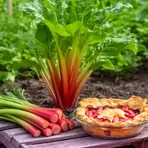
A plant with thick stems you can eat, often used in pies

A plant with thick red or green stalks that taste tart and are cooked in pies
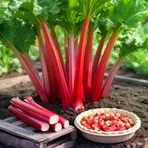
A plant with thick edible stalks often used in cooking like pies

A plant with tart edible stems that people cook and eat in pies
Surface Forms
Morphology
The noun phrase 'rhubarb plant' is a direct composition of 'rhubarb' (a garden plant with edible stalks) and 'plant' (a living photosynthetic organism), so its meaning — the plant that is rhubarb — is immediately derivable. This is non-idiomatic and follows a common cross-linguistic naming pattern, so a B1 learner who knows both constituents would understand it.
Etymology
Rhubarb plant names the garden plant whose word rhubarb points to the sour stalks people cook to eat, while its large leaves are 'poisonous'. This image of bright stalks in pies and dangerous leaves helps you remember that the phrase means the plant with 'edible' stalks when cooked.