

rhodopsin


 1
9.9
1
9.9
- noun
- /roʊˈdɑːp.sɪn/
- Specialized
- In particular, both people and coelacanths possess a visual pigment called rhodopsin, which enables them to see in dim light.
- gene encoding rhodopsin
Examples
-
Palczewski K. 2006. G protein-coupled receptor rhodopsin. Annual Review of Biochemistry 75: 743-767.
Academic text (2012) -
Apparently, one of the key factors in human night vision is a chemical in the rod cells of the eye called rhodopsin.
-
We are unable to see anything clearly, but eventually we can thanks to the rhodopsin in our eyes.
-
When light strikes rhodopsin, a change in configuration produces a visual signal.
Blog text (15) -
Each rod has at its tip a segment that contains rhodopsin photopigment, a substance that changes chemically in the presence of light.
Blog text (8) -
Dim-light vision is controlled mostly by rhodopsin pigments in rod photoreceptor cells.
Academic text (2012) -
Photons absorbed in the outer segment cause a rearrangement of rhodopsin molecules, which initiates a sequence of chemical events resulting in the excitation of an optic nerve signal.
Blog text (8) -
Munz FW, McFarland WN. 1973. The significance of spectral position in the rhodopsins of tropical marine fishes. Vision Research 13: 1829-1874.
Academic text (2012) -
The presence of rhodopsin allows owls to have exceptional night vision in dark environments.
-
When exposed to light, rhodopsin undergoes a chemical change that initiates vision.
Synonyms
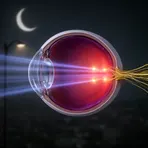
A red substance in the eye that helps you see in dim light

A reddish purple substance at the back of the eye that helps you see in dim light
Surface Forms
Morphology
Etymology
Rhodopsin comes from Greek parts rhod- meaning 'rose' or 'red' and ops meaning 'eye'. So it literally means 'red eye', which helps you remember that rhodopsin is the red pigment in the eye's rod cells that starts the process of seeing in low light.