

reptilian
 19
5.5
19
5.5

- adjective
- /rɛpˈtɪliən/
- All these are part and around the brain stem, which is the reptilian brain, the primitive brain.
- reptilian placenta
- reptilian brain
Loading YouTube…
Watch on YouTubeOK, now if I So that's my emotional brain and wherever you see my thumb, that's my reptilian brain, which is responsible for fight flight.
- OK, now if I So that's my emotional brain and wherever you see my thumb, that's my reptilian brain, which is responsible for fight flight.
- I sits mainly it's there's a part in the sort of the reptilian part of your cat's brain that just needs to feel safe.
- What part of my reptilian brain is latched on to that where this other stuff is non negotiable?
- But when I talk to most people about a declining economy, you know, and they can't think anymore, they go reptilian.
- If you look at the parts of the back of the brain, we too have the reptilian brain that governs our understanding of space, where we are in space.
- But it's like this real, like shallow reptilian brain of theirs that it's like real black and white thinking where there's so much about the United States that I love.
Examples
-
His eyes were small, reptilian, and his upper lip was twisted by a curving scar.
Fiction book (1997) -
The creature's thick reptilian tail is wrapped around her torso, holding her fast against his thighs.
Fiction book (2000) -
It's like a reptilian way of dealing with fear.
-
In some ways, hyraxes seem more reptilian than mammalian.
Academic text (2009) -
The winsome woman abruptly transformed into a creature more reptilian than human.
Fiction book (1992) -
The documentary explored the unique features of reptilian creatures in their natural habitat.
-
Many people are fascinated by the reptilian characteristics of snakes and lizards.
-
Her fascination with reptilian behavior led her to study reptiles in the wild.
Synonyms

 1
9.9
1
9.9
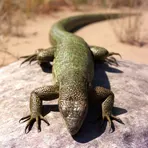
Having the shape and scaly skin of a lizard

Having dry, bumpy skin like a lizard or snake

Having a lizard's look or movement, often quick and not showing much feeling
Compounds

How Snake-like

Surface Forms
Morphology
Etymology
Reptilian comes from the Latin reptilis ('creeping'), from repere ('to crawl'), and shares the same root as reptile. So when we call movement or skin reptilian, we mean it moves or looks like a 'creeping' reptile.