

relativity theory
 1
6.5
1
6.5

- noun
- /ˌrɛlətɪˈvælɪti ˈθɪəri/
- Specialized
- The effect of Einstein's relativity theory is very small but overturned Newton's theory.
- quantum and relativity theory
- mechanics and relativity theory
Loading YouTube…
Watch on YouTubeWe're looking for the reality that's beyond space-time in which in fact the very language of quantum theory and and relativity theory don't hold.
- We're looking for the reality that's beyond space-time in which in fact the very language of quantum theory and and relativity theory don't hold.
Examples
-
Einstein's relativity theory explains how time and space are interwoven, affecting our understanding of the universe.
-
Relativity theory essentially states that there is no absolute, separate space and time.
Academic text (2001) -
I'm talking about relativity theory and quantum mechanics here.
Blog text (32) -
Relativity theory and quantum theory, in particular, overturned everything that had gone before.
Academic text (2001) -
Under these conditions, relativity theory predicts that they will perceive the same events differently.
Academic text (1994) -
KITZ Doctor, isn't it true that wormholes are merely predictions of relativity theory?
Fiction book (1997) -
For Bohm, the insights of quantum mechanics and relativity theory point to a universe that is undivided and in which all parts "merge and unite in one totality."
Academic text (1993) -
Bohm began with the troubling concern that the two pillars of modern physics—quantum mechanics and relativity theory—actually contradict each other.
Academic text (1993) -
The principles of relativity theory suggest that observers moving at different speeds will experience time differently.
-
Many scientists continue to explore the implications of relativity theory in modern physics and astrophysics.
Synonyms
 43
8.1
43
8.1
A theory in physics that space and time change depending on how you move
 12
6.7
12
6.7
A scientific idea that space and time are linked and change with motion and gravity
 3
6.8
3
6.8
A scientific idea that says space and time change depending on speed and gravity
Surface Forms
Morphology
The phrase is fully compositional: 'relativity' names the concept and 'theory' denotes a scientific explanation, so 'relativity theory' straightforwardly means the scientific theory about relativity. This head–modifier noun combination follows standard cross-linguistic patterns and is not idiomatic, so a B1 learner who knows both constituents should understand it.
Etymology
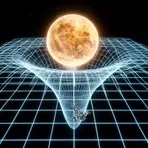
Relativity theory is often imagined as a soft, stretchy sheet: heavy objects make dents and moving things change the sheet, which helps you picture how space and time can bend. This image shows why relativity theory says 'space' and 'time' are 'not fixed' but change with speed or near heavy objects, so people in different situations can measure time and distance differently.