

recessive
- noun
- /rɪˈsɛsɪv/
- Specialized
- Christopher: I haven't read much on the mechanism of the recessive bi-black, but I'll note that the recessives I'm talking about here are typically loss-of-function mutations.
Examples
-
Slower inbreeding may cause less inbreeding depression, given that more generations are available for selection to act, purging deleterious recessives.
Academic text (2010) -
In some plants, a recessive gene can lead to a specific color only when paired with another recessive gene.
-
"It was the most monetarily important recessive that we've ever had to deal with," he says.
Academic text (1996) -
A tinier and tinier fraction of that population is a recessive homozygote.
-
To express the trait governed by a recessive allele, an individual must inherit two copies from its parents.
-
The offspring of two carriers for the recessive trait have a probability of one in four to exhibit that trait.
Synonyms

 2
4.0
2
4.0

A part passed from parents that causes a feature only if two copies are present

A form of a gene that shows only when both copies are the same
Antonyms

Compounds
- Specialized
2
4.0
A part passed from parents that causes a feature only if two copies are present

- Specialized
A genetic condition caused when a child gets two faulty copies of the same gene on a non-sex chromosome

- Specialized
A disease that appears when a child gets two copies of a faulty gene on a non-sex chromosome
- Specialized
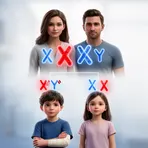
A pattern where a gene on the X chromosome causes males to have a trait and females to be carriers
How Dominant
- Specialized

- Specialized
Surface Forms
Morphology
Etymology
The noun recessive comes from the same Latin parts re- 'back' and cedere 'to go', seen in recede and recess, and it names an allele that is 'pushed back' by a dominant allele. That's why a recessive only affects a trait when there is no dominant allele to hide it.