
pyroelectricity
- noun
- /ˌpaɪroʊɪˈlɛktrɪsɪti/
- Specialized
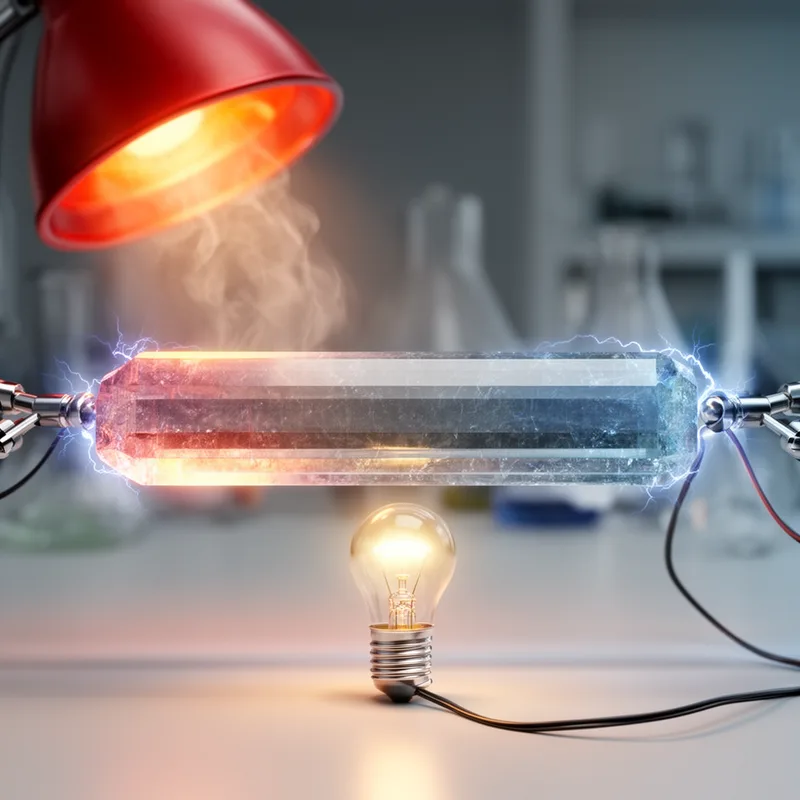
- The process of pyroelectricity enables certain crystals to generate an electric charge when their temperature changes.
Examples
-
One of the least-known properties of solid materials, pyroelectricity is rigorously defined as the temperature dependence of the spontaneous polarization in certain anisotropic solids.
Academic text (2005) -
This treatment of pyroelectricity in terms of a change in net dipole moment emerged in modern times.
Academic text (2005) -
Pyroelectricity has been known for 24 centuries.
Academic text (2005) -
A more quantitative understanding of pyroelectricity emerged during the 19th century as more sophisticated research techniques were developed.
Academic text (2005) -
In 1824, David Brewster, famous for his work in optics, was the first author to use the term "pyroelectricity."
Academic text (2005) -
In 1717, the physician and chemist Louis Lemery wrote the first scientific description of pyroelectricity in a journal.
Academic text (2005) -
Then interest in pyroelectricity virtually vanished until 1938, when Yeou Ta published a paper that initiated the great growth that continues in the field today.
Academic text (2005) -
William Thomson (Lord Kelvin) published the first major theoretical treatment of pyroelectricity in 1878; his paper included a prediction of the electrocaloric effect.
Academic text (2005) -
Scientists are studying how pyroelectricity can be utilized in devices for efficient energy conversion.
-
Understanding pyroelectricity is essential for developing sensors that monitor temperature variations.
Surface Forms
Morphology
pyroelectricity = pyroelectric (semi-transparent) = pyro + electric + ity
The word is built transparently from 'pyro' + 'electric' + '-ity', but the full scientific meaning is specialized and may not be fully predictable for a B1 learner.
Etymology
The word pyroelectricity joins pyro- meaning 'heat' or 'fire' and electricity meaning 'electric charge'. So, pyroelectricity is the electric charge a material makes when its temperature changes.

