

pyroelectric
- adjective
- /ˌpaɪroʊɪˈlɛktrɪk/
- Specialized
- Lithium tantalate is a common pyroelectric material used in infrared sensors due to its ability to generate an electric charge when heated.
- pyroelectric detectors
- pyroelectric effect
- pyroelectric material
Examples
-
Note that the pyroelectric effect is only observable during the period in which the temperature changes.
Academic text (2005) -
Physicists and engineers are likely to develop increasingly sensitive pyroelectric devices.
Academic text (2005) -
For a detailed treatment of the relations between various properties of a material and how those properties contribute to the pyroelectric effect, see box 1.
Academic text (2005) -
For details on the response and noise levels of pyroelectric detectors, see box 2.
Academic text (2005) -
The most important component of any pyroelectric device is the detector material.
Academic text (2005) -
The earliest version of a device for two-dimensional pyroelectric imaging was developed in the late 1970s.
Academic text (2005) -
In this single-element configuration intended to monitor radiation with a wavelength near 10 microns, two lead titanate pyroelectric elements are used.
Academic text (2005) -
Infrared detectors, such as the two types sketched in figure 3, can consist of single pyroelectric elements or one- or two-dimensional arrays of elements.
Academic text (2005) -
The devices operate at temperatures above the Curie level (in the so-called paraelectric phase), and an applied electric field induces the pyroelectric effect.
Academic text (2005) -
Triglycine sulfate (TGS) and its isomorphs have very favorable properties, including high pyroelectric coefficients and relatively low permittivity.
Academic text (2005)
Synonyms

Able to make a small electric charge when its temperature changes
Compounds
- Specialized
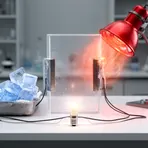
A material that makes an electric charge when heated or cooled
Surface Forms
Morphology
Etymology
Pyroelectric comes from the Greek parts pyro- meaning 'fire' or 'heat' and electric (from the Greek word for 'amber', a material known for making static electricity). So a pyroelectric material makes an electric charge when it gets hotter or colder.

