
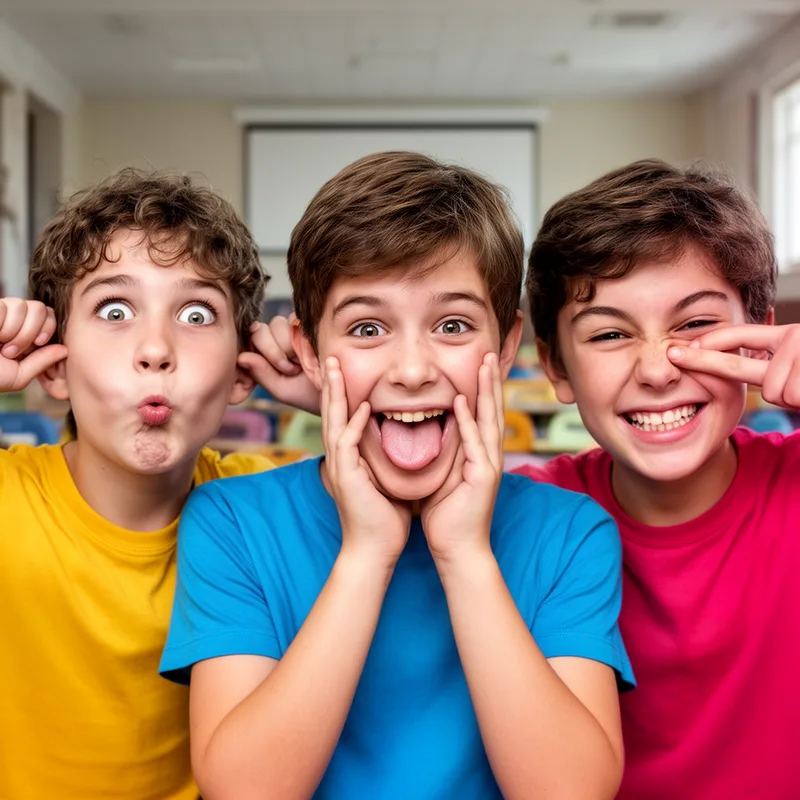
to pull faces


 1
6.3
1
6.3
- phrasal verb
- UK
- And then they whine and pull faces that no one watches them.
Loading YouTube…
Watch on YouTubeEverybody obviously was dead curious and you know, people pulling faces and, and just trying to put them off really.
- Everybody obviously was dead curious and you know, people pulling faces and, and just trying to put them off really.
Examples
-
She loves to pull faces in photos to amuse her friends.
-
Everybody obviously was dead curious and you know, people pulling faces and, and just trying to put them off really.
-
I used to drive my mum mad, pulling faces.
-
He pulled faces and made insulting gestures every time Ua's eyes might be on him.
Fiction book (1999) -
The clown pulled faces to entertain the children at the party.
-
During the movie, my friend kept pulling faces to make me laugh.
Synonyms
 41
3.4
41
3.4
To push out your lips to show that you are annoyed or disappointed
 29
4.4
29
4.4
To twist your face to show pain, disgust, or a forced smile
 18
3.2
18
3.2
Move parts of your face to show dislike, pain, or to be funny
 4
6.0
4
6.0
To move the nose so it makes small lines to show you do not like something
 1
5.5
1
5.5
Make a face to show dislike or discomfort
How Expressive

Surface Forms
Morphology
The meaning is readily inferable from the parts: 'pull' evokes changing or tugging and 'face' refers to facial expression, so learners can picture contorting one’s face and predict it means making funny or exaggerated expressions. Though 'pull' is used metaphorically rather than literally, the compositional image is straightforward and cross-linguistically supported (many languages have equivalent "make/make faces" constructions), making it predictable for a B1 learner who knows both words.
Etymology
Pull faces comes from the simple picture of someone using their hands or muscles to pull their faces into strange, funny shapes. That's why it now means making very strange or silly looks 'to amuse' or 'to annoy' other people.