

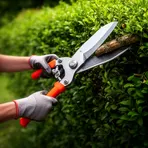
pruning shears
 1
3.2
1
3.2

- noun
- /ˈpruːnɪŋ ʃɪrz/
- Before planting new flowers, make sure to clean your pruning shears for best results.
- a pair of pruning shears
- using pruning shears
Loading YouTube…
Watch on YouTubeThere's fruit on it right now, but I'm still holding some pruning shears and I'm going to cut it.
- There's fruit on it right now, but I'm still holding some pruning shears and I'm going to cut it.
Examples
-
I need pruning shears.
-
Anyone seen my pruning shears?
-
That's why I wear these funny clothes and carry these pruning shears as part of my job.
-
See the way the handle on those pruning shears matches her gardening clogs?
-
There's fruit on it right now, but I'm still holding some pruning shears and I'm going to cut it.
-
We worked side by side while my grandmother scurried about her flower garden, singing Italian songs and keeping time with her pruning shears.
Fiction book (1995) -
Shelby decided to give it that opportunity, so he took his pruning shears inside the house, leaving the front gate open for the dog to exit through.
Fiction book (2002) -
The tub of the day rests snugly therein, along with a pair of gloves and pruning shears.
Blog text (27) -
I used my pruning shears to trim the overgrown branches in the garden.
-
Using pruning shears, she carefully shaped the rose bushes into perfect form.
Synonyms

 1
3.0
1
3.0
Large strong scissors for cutting thick things like hedges or cloth
How Long

Surface Forms
Morphology
The noun phrase is compositionally built from 'prune' (to trim plants) + 'shears' (large scissors), so its meaning — scissors used for pruning — is directly derivable from the constituents. This is a common, cross-linguistic instrument noun formation and would be readily understood by a B1 learner who knows the two words.
Etymology
Pruning shears comes from gardening: they are strong, hand-held scissors called shears used for pruning, which means 'cutting back' dead or old parts of a plant. So the name simply describes the hand tool used to cut small branches and stems.