
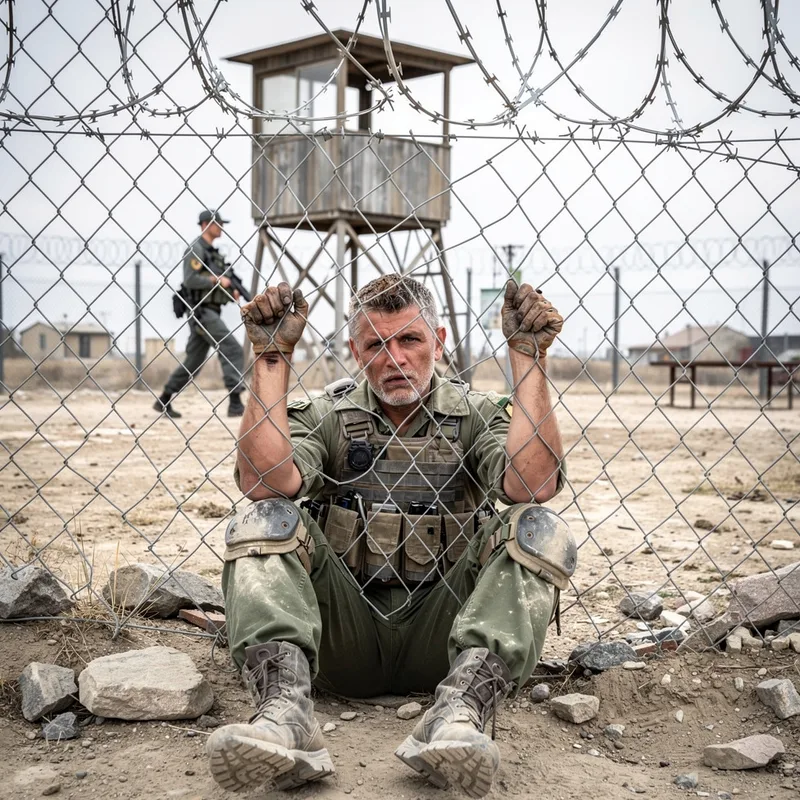
prisoner of war
 137
3.9
137
3.9

- noun
- /ˈprɪzənər əv wɔr/
- During the conflict, hundreds of soldiers were taken as prisoners of war and held in various camps.
- a prisoner of war camp
- treatment of prisoners of war
- detained as a prisoner of war
Loading YouTube…
Watch on YouTubeThey served as guards to Confederate soldiers, military convicts and prisoners of war.
- They served as guards to Confederate soldiers, military convicts and prisoners of war.
- You know, so this came with, you know, experience from prisoners of war in the Special Forces Regiment.
- And they had three prisoners of war who obviously would have been incentivized to make noise.
Examples
-
Our mission is accomplished; we have a cease-fire, and our prisoners of war are coming.
Fiction book (1995) -
Treat him like a North Korean prisoner of war.
-
We met when I was a prisoner of war.
-
You are a prisoner of war.
-
Keep him as a prisoner of war.
-
- That man is a prisoner of war, Doctor.
-
This man is not a prisoner of war.
-
And he carried that forward with him when he became a prisoner of war during the Vietnam conflict.
-
He was a prisoner of war.
-
McLaughlin offers a detailed description of his experience as a prisoner of war.
Academic text (2010)
Synonyms
 ∞
1.1
∞
1.1
A person kept locked because they broke the law or were captured during a war
 216
6.5
216
6.5
A member of the armed forces captured and held by the enemy during war
 57
4.6
57
4.6
A person or animal kept as a prisoner and not free
Surface Forms
Morphology
prisoner + of + war
The meaning 'a person captured and held by the enemy during war' is directly and literally derived from combining 'prisoner' (someone held captive) with 'war' (armed conflict) using the relational 'of' construction. This noun-of-noun pattern is cross-linguistically common and follows straightforward composition, so a B1 learner who knows the constituent words would readily infer the MWE meaning.
Etymology
Prisoner of war shows a simple picture: a prisoner taken because of war, for example a soldier held in a camp after a battle. So it means 'a person captured and held by the enemy'.