
present participle


 1
3.3
1
3.3
- noun
- /ˈprɛzənt ˈpɑːrtɪsɪpəl/
- Specialized
Loading YouTube…
Watch on YouTubePast and present participles are often inflected as adjectives, even when they form paraphrastic verb forms.
- Past and present participles are often inflected as adjectives, even when they form paraphrastic verb forms.
Examples
-
Take, for example, the case of the Old Spanish present participle, veyendo, which was eventually replaced by vendo.
Academic text (2001) -
The word game here involves both morphology and syntax, as the present participle can function as a verb or as an adjective.
Academic text (1996) -
Such titles challenge normative grammar, for instance, the instructions of the American Heritage Dictionary concerning the need for avoiding "ambiguities" in the use of the present participle (955).
Academic text (1996) -
bell hooks accumulates the puns, as her subtitle Resisting Representations comes under the preceding category of the ambiguous present participle.
Academic text (1996) -
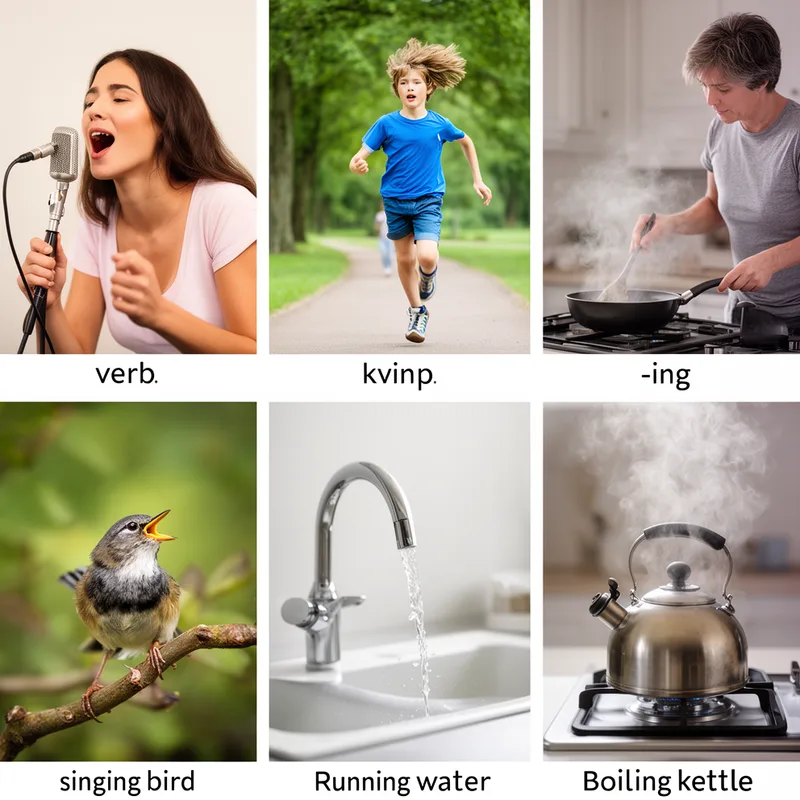
The word 'running' is an example of a present participle, showing an ongoing action.
-
In English, the present participle is formed by adding '-ing' to the base verb, like 'swimming'.
-
You can easily recognize a present participle by its '-ing' ending, such as in 'reading' or 'dancing'.
Surface Forms
Morphology
The meaning 'a verb form expressing ongoing action' is directly and transparently built from 'present' (current/ongoing) + 'participle' (a verb form), so a learner who knows both constituents can infer it refers to the participle form marking present/ongoing action (English -ing). This compositional grammatical label follows common cross-linguistic naming patterns and standard morphology, making it immediately comprehensible to B1 learners who know the component words.
Etymology
Present participle combines present, meaning 'now', and participle, meaning a 'part' of the verb, to name the verb form made by adding '-ing' that shows an action in the middle of happening. So words like 'running' or 'singing' are present participles because they show 'ongoing action'.