

prairie sage
- noun
- /ˈprɛəri seɪdʒ/
- US
- The prairie sage bloomed throughout the summer, its silvery leaves adding texture to the open fields.
Examples
-
Botanists are studying how prairie sage adapts to arid climates in the Southwest.
-
Local artisans use dried prairie sage leaves in traditional herbal remedies.
-
The prairie sage grows abundantly in the desert regions.
-
Many gardeners love to cultivate prairie sage for its unique appearance.
-
Local artisans use dried prairie sage leaves in traditional herbal remedies.
-
The prairie sage bloomed throughout the summer, its silvery leaves adding texture to the open fields.
-
Many gardeners love to cultivate prairie sage for its unique appearance.
Synonyms

A plant that lives for several years with soft white leaves often called white sage
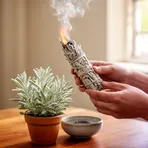
A plant with silvery white leaves that people often burn in rituals for healing

A plant with soft white leaves that smell strong and lives for many years in the southwestern United States

A low plant with soft white leaves that lives in dry places
Surface Forms
Morphology
The compound 'prairie sage' is a straightforward noun phrase combining 'prairie' (a grassland) and 'sage' (an herb), so a learner who knows both words can infer it refers to a type of sage associated with prairie regions. There is no idiomatic or metaphorical shift in meaning, so its sense is compositionally transparent and predictable from the constituents.
Etymology
The noun prairie sage comes from a simple image: it is a kind of sage that grows on open prairie land and has soft, silvery, cottony leaves. People in the dry Southwest used its leaves as a small 'herb', so the name came to mean this plant that lives for many years.

