

pork and beans
 3
1.5
3
1.5

- noun
- /pɔrk ənd binz/
- US
- Hughes stopped his car in front of the Red Star Market, with its banners advertising pork and beans, heads of cauliflower, and dish soap.
- canned pork and beans
- eat the pork and beans
Examples
-
Pinto and navy beans account for 5 of those pounds, eaten mostly as refried beans (pintos) or as canned pork and beans (navy).
Academic text (2000) -
And can I have some pork and beans with that?
-
Who goes to a concert today carrying cans of pork and beans and tuna?
Blog text (1) -
- Well, sir, there's that tin of pork and beans.
-
Joe, Frank, Doc, and Spot floated around the control cabin eating pork and beans from cans and drinking orange pop.
Fiction book (1996) -
And you can create those memories with delicious meals just like these BBQ pork and beans tacos.
-
They could eat tuna, pork and beans, and peaches right out of the cans.
Fiction book (2002) -
Finally free from my blue-collar beginnings in a Texas double-wide, where my mother cooked with recipes from the labels on cans of pork and beans, I now live in a completely different world.
Fiction book (2002) -
"I've wined and dined with kings and queens; I've slept in alleys and eaten pork and beans."
Blog text (13) -
For dinner, we enjoyed a hearty bowl of pork and beans topped with a sprinkle of cheese.
Synonyms
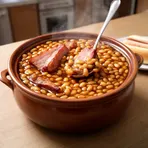
A slow-cooked New England dish of small white beans in thick sweet syrup with salted pork
Surface Forms
Morphology
The meaning 'a dish consisting of pork and beans' is directly and compositionally derived from the constituents 'pork' + 'and' + 'beans' — it literally names the foods combined. This kind of food-naming pattern is cross-linguistically common and follows standard compositional semantics, so a B1 learner who knows the individual words will readily infer the MWE meaning (with only cultural detail about canned preparation remaining optional).
Etymology
Pork and beans comes from the simple food of cooked pork mixed with beans, often sold in a can. Picture a can of soft beans with small pieces of pork, and that's why the phrase means that easy, cheap 'dish' today.