
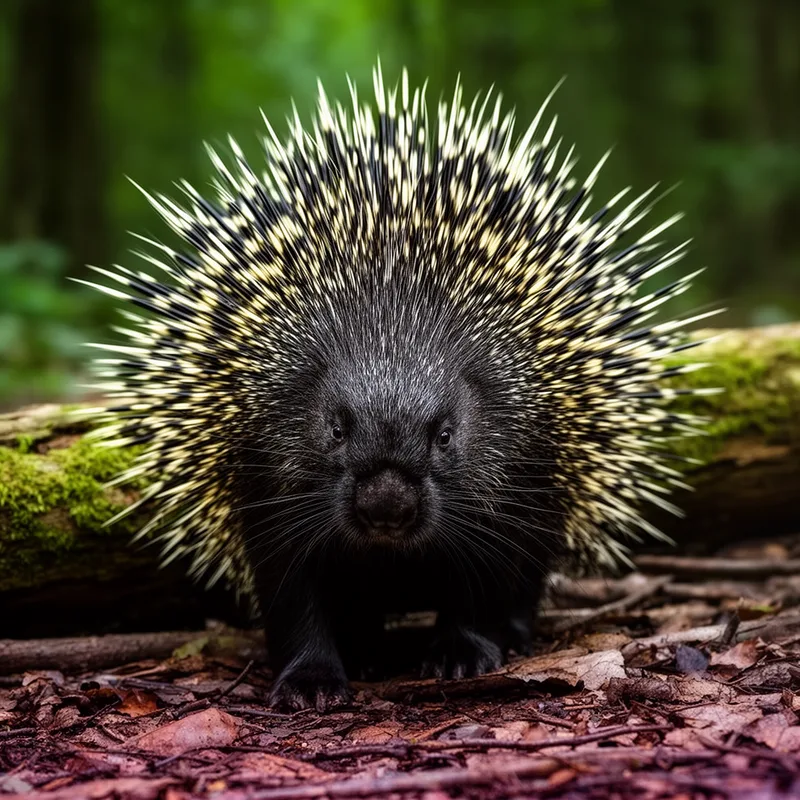
porcupine
 28
2.8
28
2.8

- noun
- /ˈpɔrkjəˌpaɪn/
- In the foreground, a family of porcupines—a momma and two kids—are crossing the road.
- porcupine quills
Loading YouTube…
Watch on YouTubeI think she took a porcupine quill in my shoulder.
- I think she took a porcupine quill in my shoulder.
- She walks barefoot on the grass, even though the father tells her not to, saying, and he's right, that there might be porcupines, Hornets, snakes.
- So when they are like that, when the porcupine has its thing up, you must just keep away a bit.
- But the forecasts go up like this, like my fingers on my hand, but are like the spines on a porcupine.
- Say more so porcupines can throw their quills.
- And when I was there, they at porcupine and all kinds of porcupine are also vegetarian.
- Oh, look, the Red King have a fucking porcupine up here.
- A cannonball out of a you think a cannonball pirate crazier than a porcupine?
Examples
-
The porcupine's coat is covered in sharp quills, which it uses to protect itself from attacks.
-
On top of the doghouse, the porcupine glares down at him
Fiction book (2001) -
And much like trying to save an injured porcupine, you may feel bad for the creature, but you are going to get stuck by their quills.
-
There's a porcupine who inflicts real pain with porcupine quills.
-
The craft bristled with so many spears that it resembled the back of a porcupine.
Fiction book (1999) -
The porcupine raised its quills in defense when it felt threatened by a nearby predator.
-
While hiking, I was careful not to disturb the porcupine, as its sharp spines could cause injury.
Compounds

- Specialized
A large animal with sharp spines and a brush of stiff hairs at the end of its tail
- Specialized
A rodent with a brush of stiff, bead-like hairs at the tip of its tail

A large North American animal with sharp quills hidden in coarse fur that climbs trees and gnaws wood for salt

A small spiny animal with short quills and a long tail from Borneo and Sumatra

- Specialized
A porcupine from the Americas that lives in trees and has a tail that can hold branches


- Jargon
A rule a company uses to stop a takeover by making itself less attractive to other companies
Surface Forms
Etymology
The word porcupine comes from old parts porcus 'pig' and spina 'thorn', so it originally meant 'thorny pig' and gives the picture of a pig covered in sharp points. That's why a porcupine is a large rodent covered in sharp spines or quills that it uses to defend itself.