
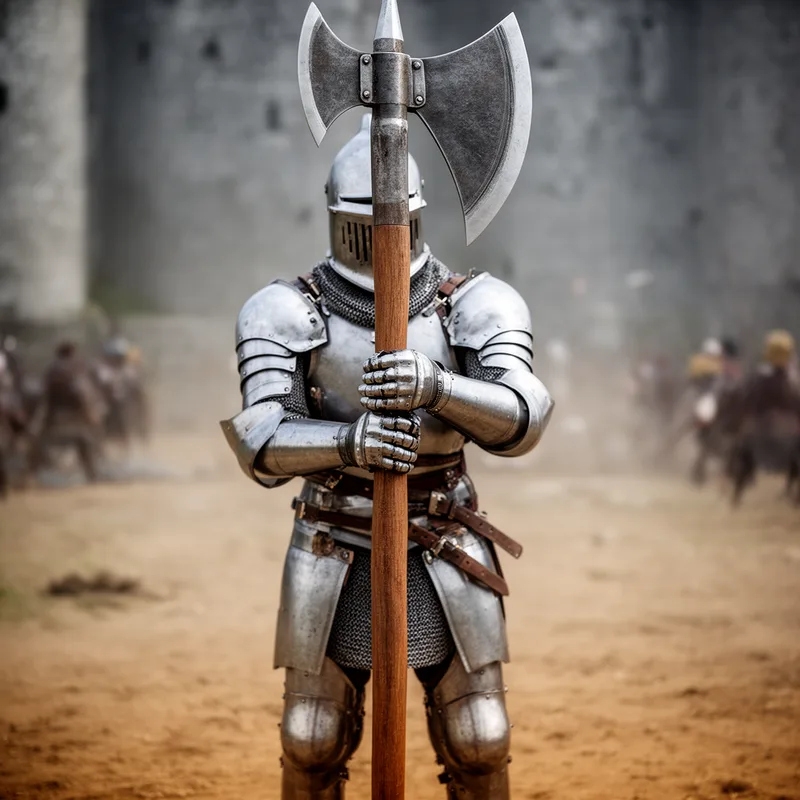
poleaxe
- noun
- /ˈpoʊlˌæks/
- Archaic
- The butcher selected a heavy poleaxe to slaughter the animals swiftly.
Examples
-
Aria could not imagine them turning their poleaxes against a prince of the blood, backed by dozens of boyars, not unless she gave them some incredibly good reason.
Fiction book (2002) -
In medieval times, soldiers often used a poleaxe for close combat during battles.
-
Poleaxes lashed out.
Fiction book (2002) -
Looking past their stone faces into the hall below, all she saw at first were bared blades: the boyars' drawn swords, the Gendarmes' poleaxes, and the guards' halberds.
Fiction book (2002) -
The warrior swung his poleaxe to defend himself against the charging enemy.
Synonyms


 1
9.9
1
9.9
A long shaft with a blade or point used to fight from a distance
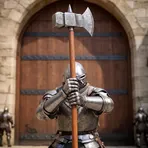
A long-handled ax with a hammer or spike used in medieval battles

A long wooden pole with a sharp or heavy end used for fighting

A weapon with a hammer on one side and an axe blade on the other
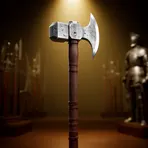
A weapon with a hammer head on one side and an axe blade on the other for fighting
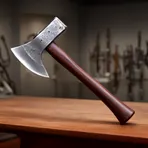
A tool with an axe blade on one side and a hammer on the other for fighting or work
How Heavy

Surface Forms
Morphology
Etymology
Poleaxe is made of the two simple parts pole and axe, so imagine an axe on a long handle. That strong image explains the word: it names a heavy axe used in battle or for slaughtering animals.