

poleax
- noun
- /ˈpoʊlˌæks/
- Archaic
- During the reenactment, the actor skillfully swung his poleax to demonstrate its use in medieval warfare.
Examples
-
In medieval times, a poleax was a common weapon.
-
During the siege, soldiers used a poleax to breach the castle doors.
-
Museum visitors admired the ornate poleax on display in the medieval armor collection.
-
The knight wielded a heavy poleax during the tournament.
-
The knight wielded a poleax during the battle.
-
The knight raised his poleax in preparation for the battle to come.
-
The warrior carried a majestic poleax, a formidable weapon designed for close combat.
Synonyms


 1
9.9
1
9.9
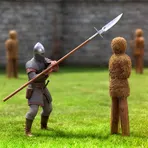
A long shaft with a blade or point used to fight from a distance
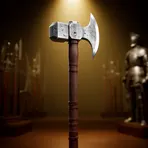
A weapon with a hammer head on one side and an axe blade on the other for fighting

A heavy axe with a long handle used in battle

A long wooden pole with a sharp or heavy end used for fighting
How Heavy

Surface Forms
Morphology
Etymology
Poleax comes from joining pole 'long stick' and axe 'cutting tool', so it originally meant an ax on a long handle used in battle. That's why a poleax was a heavy weapon for breaking armor, gates, or shields.