

to poke at
 9
2.5
9
2.5

- phrasal verb
- /poʊk æt/
- I poked at it with a stick.
- poke at the food
- fork to poke at
- poked at with a stick
Loading YouTube…
Watch on YouTubeYou get a wound and then you're poked at with a knife until you have a wound and then then you smear ash in the wound, which itself is a poem.
- You get a wound and then you're poked at with a knife until you have a wound and then then you smear ash in the wound, which itself is a poem.
Examples
-
He always liked fires and poking at them with a stick.
-
Leda and Pearline giggled and poked at each other and at Ruth.
Fiction book (1994) -
"Pulling his drink closer to him, Albert poked at the ice in his glass.
Fiction book (1997) -
A lot of them were poking at the bases of the three towers.
Fiction book (1995) -
"I went back to the kitchen and poked at the carrots."
Fiction book (1996) -
Eric chews on some roots and pokes at the fire to keep it lively.
Fiction book (1993) -
The baby went back to poking at the small dent he'd made in the ground.
Fiction book (1990) -
Then he got out, opened the hood, tugged at hoses, and poked at wires.
Fiction book (1990) -
The goldfish stall man struggles to keep control as Billi pokes at the fish prizes in their polythene bags.
Fiction book (1991) -
The child gently poke at the pile of leaves to see if any hidden animals were inside.
Synonyms
 50
2.4
50
2.4
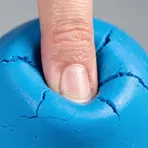
To push something quickly into a person or thing
 33
3.8
33
3.8
To push someone gently with an elbow or hand to get attention
 4
3.7
4
3.7
To poke a person, animal, or object with a stick
Antonyms

How Forceful

Surface Forms
Morphology
poke + at
The meaning 'to push or prod something' is directly compositional from 'poke' (to prod or push) plus the preposition 'at' which marks the target of the action; there is no idiomatic shift. This verb + preposition pattern is structurally transparent and common cross-linguistically, so a B1 learner who knows both constituents would readily infer the MWE meaning.
Etymology
The phrasal verb poke at comes from the simple image of using a finger or a stick to poke something at it, like tapping or nudging to see what will happen. That's why it means 'to push or prod something or someone gently'.