
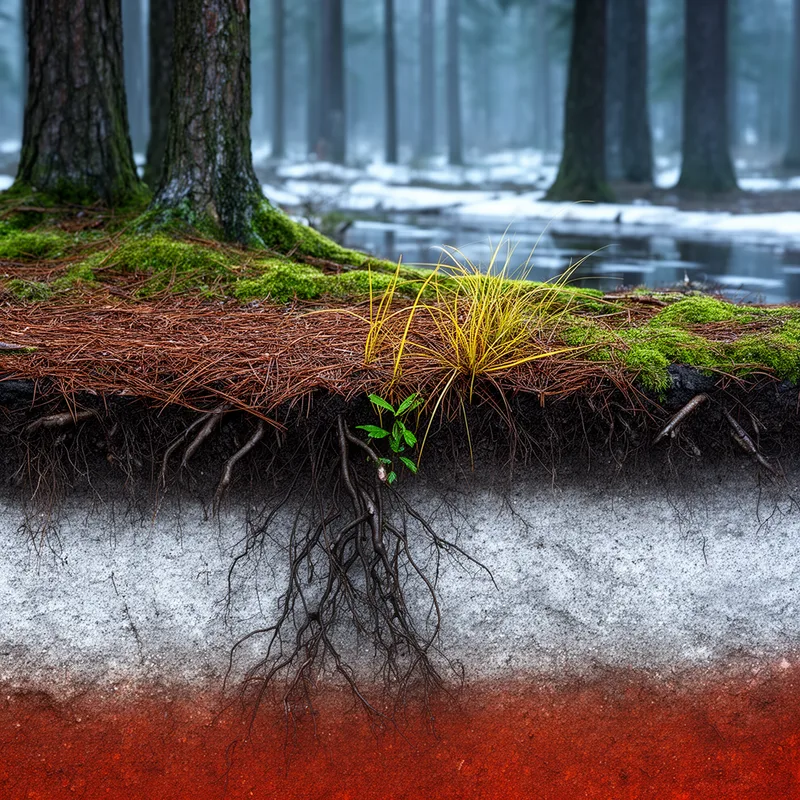
podzol soil
- noun
- /ˈpɒdzəl sɔɪl/
- Specialized
- In northern forests, podzol soil develops beneath layers of pine needles and moss.
Examples
-
Many crops struggle to grow in podzol soil due to its low nutrient content.
-
Researchers analyze podzol soil to understand boreal forest ecosystems.
-
The forest is rich in podzol soil.
-
Many plants thrive in podzol soils.
-
In northern forests, podzol soil develops beneath layers of pine needles and moss.
-
Many crops struggle to grow in podzol soil due to its low nutrient content.
-
Researchers analyze podzol soil to understand boreal forest ecosystems.
Synonyms
A soil that forms in cold, wet areas under pine trees with a dark organic mat over a pale layer

A type of acidic soil that forms under pine forests in cold, wet climates
Surface Forms
Morphology
The noun 'podzol' already denotes a specific kind of acidic soil, so combining it with 'soil' simply specifies the category; the overall meaning ('a type of soil found under coniferous vegetation') is directly derivable from the constituents. Although 'podzol' is technical vocabulary, the compositional pattern 'type-name + soil' is transparent and common across languages, so a learner who knows both words would understand the MWE.
Etymology
Podzol soil gets its name from Russian words pod (meaning 'under') and zol (meaning 'ash'), because these soils often show a pale, ash-like layer under the dark leaf litter. That's why the name describes soils with a grey, washed-out layer and low nutrients.

