
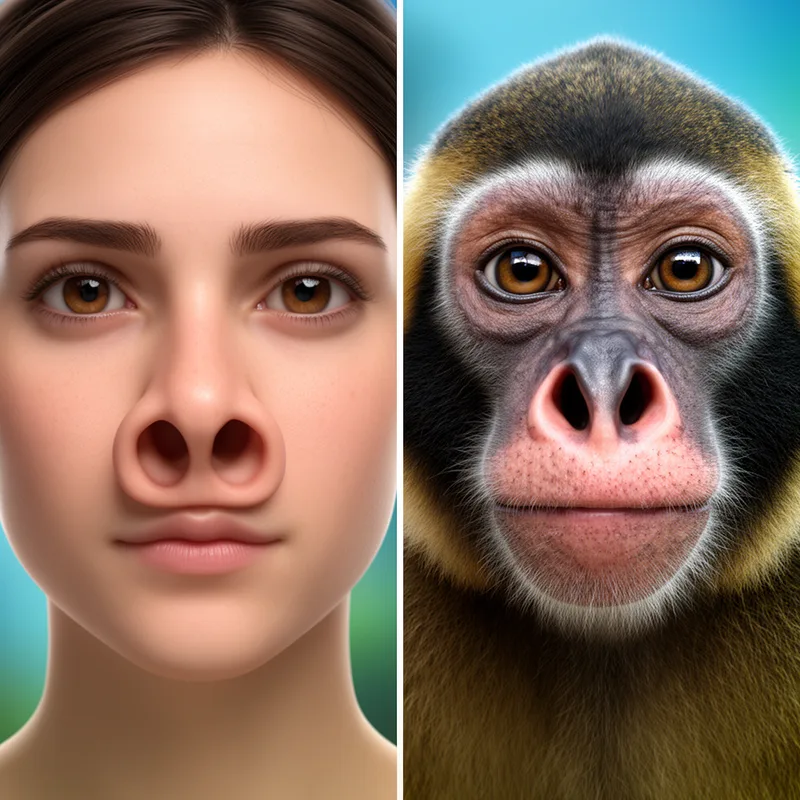
platyrrhinian
- adjective
- /ˌplætɪˈrɪniən/
- Specialized
- The platyrrhinian monkeys are native to South and Central America.
Examples
-
Researchers found that the ancient skull displayed distinctive platyrrhinian features.
-
Many platyrrhinian monkeys live in tropical rainforests.
-
Heritage studies often classify certain populations as platyrrhinian based on nasal structure.
-
The platyrrhinian species are fascinating to study.
-
Certain anthropologists focus on platyrrhinian traits to distinguish between different human populations.
-
The platyrrhinian monkeys are known for their social behavior and unique adaptations to their environment.
-
In a discussion about primate evolution, we examined how platyrrhinian characteristics influence their classification.
Synonyms

Relating to monkeys from Central and South America or people with broad, flat noses

A wide, flat nose with nostrils far apart like monkeys from the Americas

Having a wide, flat nose with nostrils far apart

Having a wide nose with nostrils far apart
A person or animal that has a wide, flat nose
Surface Forms
Morphology
platyrrhinian = platyrrhine (opaque) = platy + rrhin + ian
Formation by adding the productive suffix '-ian' to 'platyrrhine' is a regular, predictable derivation.
Etymology
Platyrrhinian comes from Greek parts platy- meaning 'broad' and -rrhin- meaning 'nose', as in rhino, so it describes people or animals with a 'broad' or widely spaced nose.

