
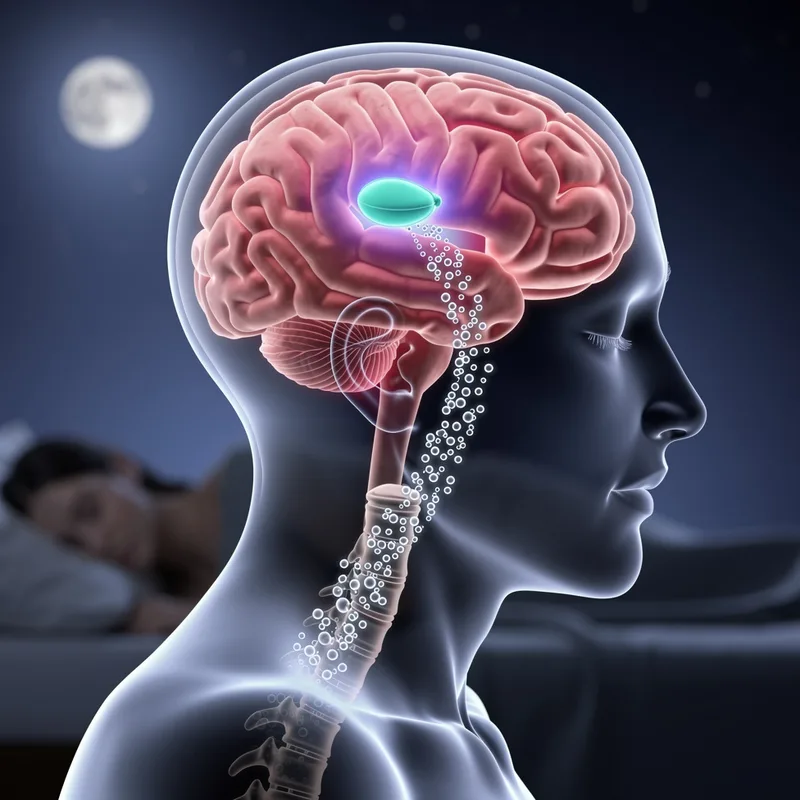
pineal gland
 5
5.6
5
5.6

- noun
- /ˈpɪniəl ɡlænd/
- Specialized
- Located in the brain, the pineal gland plays a crucial role in hormone production, particularly melatonin.
- pineal gland inside the brain
Loading YouTube…
Watch on YouTubeIt's it's, it's a it's a calcification like you said, of the pineal gland, which is your antenna.
- It's it's, it's a it's a calcification like you said, of the pineal gland, which is your antenna.
- And so I started researching it and they found a cyst in my pineal gland.
- Within our brain that means then the blood flow is able to follow with alkaline blood and that decalcifies the pineal gland.
Examples
-
Recent research on the influence of night brightness upon the human pineal gland near the brain reveals a marked effect on its secretion of melatonin and its regulation of biorhythms, possibly affecting the incidence of cancer.
Academic text (2004) -
Scientists study the pineal gland to understand its role in regulating the body's circadian rhythms.
-
But we know that the pineal gland is known by many as our third eye.
-
So as light comes into your eyes, this signal is then transferred back to the pineal gland via the master clock.
-
Melatonin is a hormone produced by the pineal gland in the brain.
Blog text (4) -
But our body is most sensitive to light and dark cues, which affect the production of melatonin by the pineal gland.
Blog text (27) -
The pineal gland produces melatonin, which regulates sleep patterns and helps us fall asleep at night.
Synonyms


 1
8.2
1
8.2
A small gland in the brain that makes melatonin and helps control sleep and daily body rhythms

A small gland in the brain that makes melatonin to control sleep

A small gland deep in the brain that makes melatonin
Surface Forms
Morphology
The noun phrase is fully compositional: 'gland' denotes an organ that releases hormones and 'pineal' specifies which gland (the pineal one), so the meaning is the gland associated with the pineal region. This modifier + noun pattern is a regular, cross-linguistic way to name anatomical structures, so a learner who already knows both constituents would readily infer the full meaning.
Etymology
Pineal gland may come from a Latin word for a small pine cone because the tiny gland looks like one. It sits deep in the brain and makes a chemical that helps control our 'sleep', so the name links the gland's shape to what it does.