
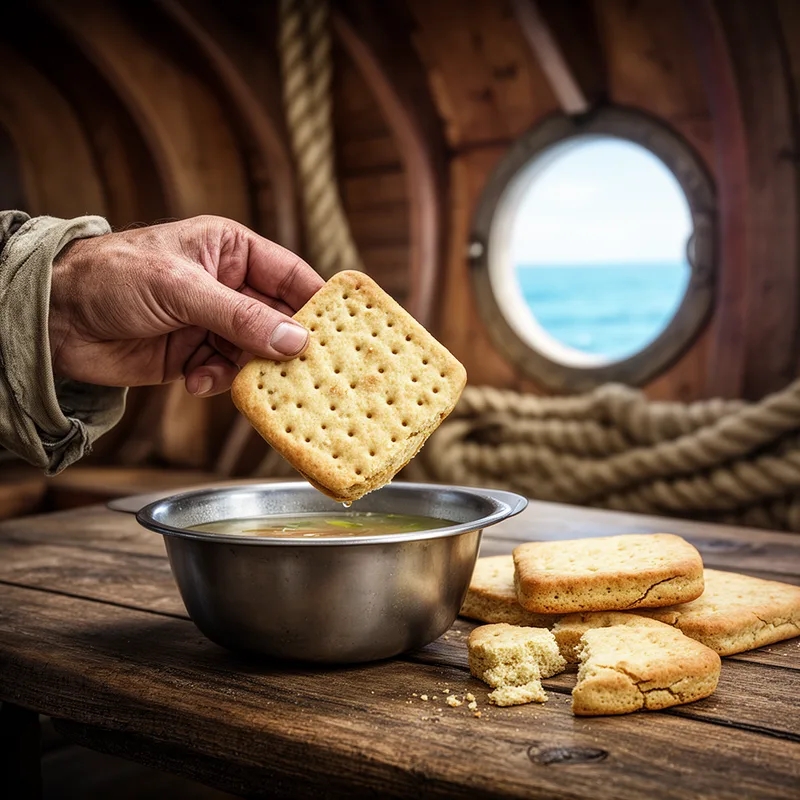
pilot biscuit
- noun
- Archaic
- Sailors often soaked their pilot biscuit in water or soup to make it edible.
Examples
-
The museum displayed a 19th-century pilot biscuit preserved from an old shipwreck.
-
The pilot biscuit was known for its durability.
-
During the long voyage, the crew survived on salted meat and pilot biscuit.
-
Sailors used to rely on pilot biscuits during long voyages.
-
During the long voyage, the crew survived on salted meat and pilot biscuit.
-
Sailors often soaked their pilot biscuit in water or soup to make it edible.
-
Sailors used to rely on pilot biscuit during long voyages.
Synonyms

 3
9.9
3
9.9

A very hard dry biscuit that sailors and soldiers ate long ago
A very hard unsalted biscuit sailors used to eat on long sea voyages
A very hard dry bread sailors soaked before eating on long sea trips

A very hard plain biscuit that keeps for a long time and sailors use on ships
How Hard

Surface Forms
Morphology
pilot + biscuit
Knowing 'pilot' (a navigator or guide) and 'biscuit' (a baked food) does not let a B1 learner infer the specialized, historical meaning 'very hard, unsalted ship's staple'; the sense is occupational and archaic rather than compositionally predictable. The modifier 'pilot' does not transparently signal hardness, durability, or nautical provisioning, and the compound's meaning is not a general cross-linguistic pattern, so learners would likely not derive it from the parts alone.
Etymology
Pilot biscuit comes from life at sea: sailors kept very hard, dry biscuit that lasted for months on long trips. One popular idea is that the name pilot showed these biscuits 'guided' or helped the crew survive the journey, so today pilot biscuit means 'a very hard, without-salt biscuit once eaten by sailors'.