
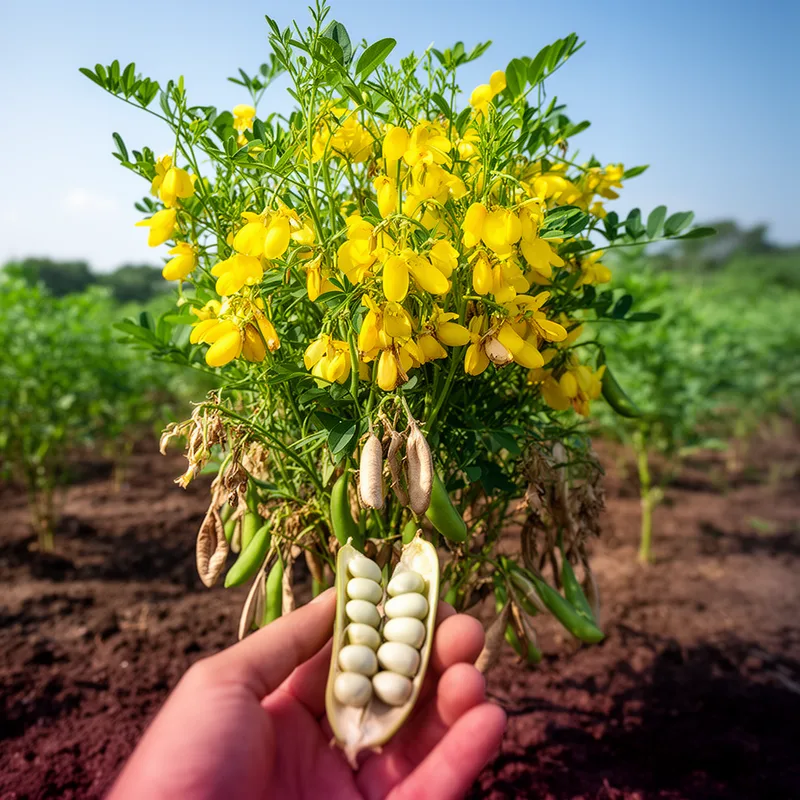
pigeon pea
- noun
- /ˈpɪdʒən piː/
- The seeds of the pigeon pea are used in many traditional stews and curries.
Examples
-
Intercropping with pigeon pea helps enrich the soil with nitrogen.
-
Farmers in India often plant pigeon pea as a drought-resistant crop.
-
The pigeon pea is rich in protein.
-
Many farmers grow pigeon peas for their high yield.
-
Farmers in India often plant pigeon pea because it is a drought-resistant crop that thrives in hot climates.
-
The seeds of the pigeon pea are commonly used in traditional dishes like stews and curries across many cultures.
-
Intercropping with pigeon pea is a sustainable practice, as it helps to improve soil nitrogen levels for better crop yields.
Synonyms

 6
9.9
6
9.9

A woody plant that grows in warm places and has bright yellow flowers and flat pods

 1
8.9
1
8.9
A tropical plant with yellow flowers and flat pods grown for edible seeds
A tropical plant with hard stems and yellow flowers that has flat pods of edible seeds

A tropical shrub with yellow flowers and flat pods that gives edible seeds

A tropical plant with yellow flowers and flat pods that makes edible seeds like peas
A tropical plant grown for its small edible seeds used like peas
Surface Forms
Morphology
pigeon + pea
The noun follows a transparent modifier + head noun pattern: 'pea' names the category (a legume) and 'pigeon' simply specifies a variety, so a learner who knows both words can infer it is a kind of pea/legume. The historical reason for the modifier ('pigeon') may be arbitrary, but this does not prevent a B1 learner from understanding the basic meaning as a type of pea with edible seeds.
Etymology
Pigeon pea may come from the plant's seeds being used as food for pigeons, while pea shows it is a pea-like plant. So the name now refers to the shrub that makes those edible seeds.