

phytoplankton
 4
8.2
4
8.2

- noun
- /ˌfaɪtəˈplæŋktən/
- Specialized
- The temperature increase leads to the phytoplankton blooms, which in turn are grazed upon by the zooplankton.
- phytoplankton productivity
- phytoplankton biomass
- phytoplankton production
Loading YouTube…
Watch on YouTubeSo everything from the temperature to the cloud cover to the color of the oceans to see what phytoplankton is doing in the oceans.
- So everything from the temperature to the cloud cover to the color of the oceans to see what phytoplankton is doing in the oceans.
Examples
-
Squid use polarized light to see the phytoplankton on which they feed.
Academic text (2011) -
For example, in a eutrophic lake sediment, microbes may break down phytoplankton and macrophytes, releasing phosphorus.
Academic text (2000) -
Thus, the loss of phytoplankton probably would have a significant impact upon all marine resources.
Academic text (1991) -
Along the California coast, they are frequently observed in areas of high phytoplankton abundance.
Academic text (1990) -
The effects of meroplankton grazing on phytoplankton are expected to be considerable.
Academic text (2000) -
During the months of high phytoplankton volumes, the occurrence of basking sharks is low.
Academic text (1990) -
Of the total carbon incorporated into phytoplankton biomass, 70% is from photoautotrophy and 30% is from ingestion of bacteria.
Academic text (1999) -
Anand Gnanadesikan and coworkers at Princeton University have recently suggested that phytoplankton may even affect the frequency of typhoons.
Academic text (2011) -
Scientists study phytoplankton because they are crucial for ocean ecosystems.
-
Phytoplankton are the foundation of the marine food web, supporting various marine species.
Synonyms
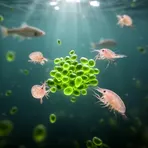
Tiny algae made of one cell that float freely in water and feed small water animals
How Small
- Specialized
4
8.2

- Specialized
- Specialized
1
8.3
1
3.0
Surface Forms
Morphology
Etymology
The word phytoplankton comes from phyto- meaning 'plant' and plankton meaning 'drifting'. So phytoplankton are tiny plant-like living things that drift in the water and form the plant part of plankton.