
phospholipase


 1
9.1
- noun
- /ˌfɑsfoʊˈlɪpeɪs/
- Specialized
- They include drugs targeted at HIV protease for the treatment of AIDS, a drug targeted at influenza virus neuraminidase to prevent flu, and a drug targeted at a phospholipase.
- phospholipase A2
- cytosolic phospholipase
Examples
-
Moreover, C. ulcerans and C. pseudotuberculosis may produce phospholipase D, the major virulence factor involved in caseous lymphadenitis, which is a disease that mainly affects sheep, goats, and horses (3).
Academic text (2014) -
Notably, mutations in the phospholipase PNPLA3 result in hepatic steatosis.
Blog text (27) -
Sokolowska M, Stefanska J, Wodz-Naskiewicz K, Cieslak M, Pawliczak R. 2010. Cytosolic phospholipase A2 group.
Academic text (2016) -
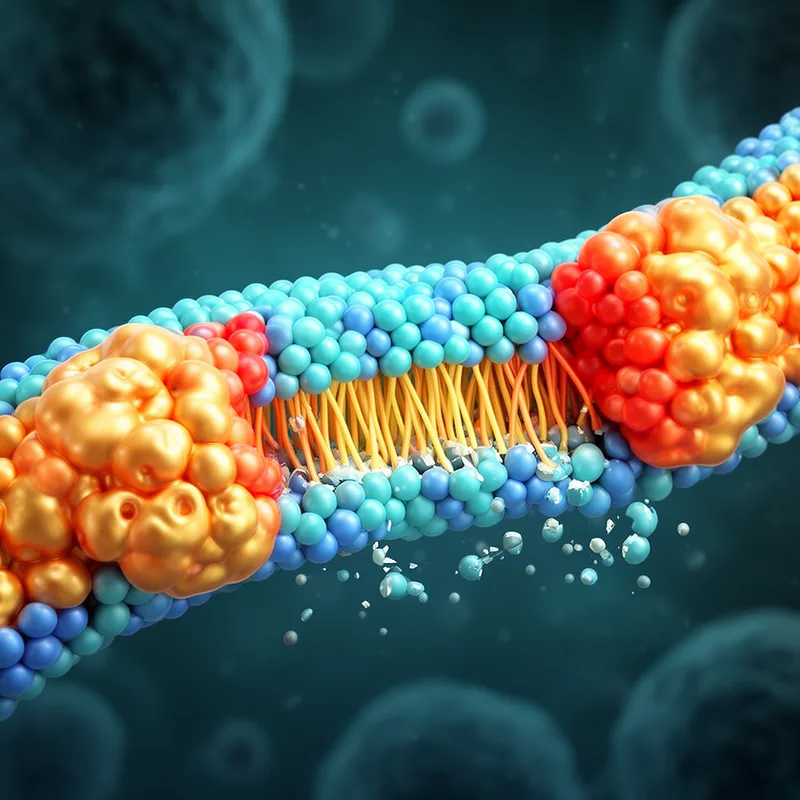
The enzyme phospholipase breaks down phospholipids in cell membranes, facilitating various cellular processes.
-
Researchers discovered that phospholipase A2 plays a crucial role in inflammation by hydrolyzing the phospholipids in membranes.
-
During the study, scientists measured the activity of phospholipase to assess its impact on fat metabolism in cells.
Surface Forms
Morphology
phospholipase = lipase (semi-transparent) = phospho + lip + ase
The word is formed by adding the combining form 'phospho-' (relating to phosphate or phospholipids) to the enzyme name 'lipase'; this is clear to learners with some scientific vocabulary but may be opaque to a general B1 learner.
Etymology
Phospholipase comes from phospho- 'with phosphate' and lipase 'an enzyme that breaks fats', with lip- like in lipid. So a phospholipase is an enzyme that breaks the fat-like molecules called phospholipids found in cell membranes.