
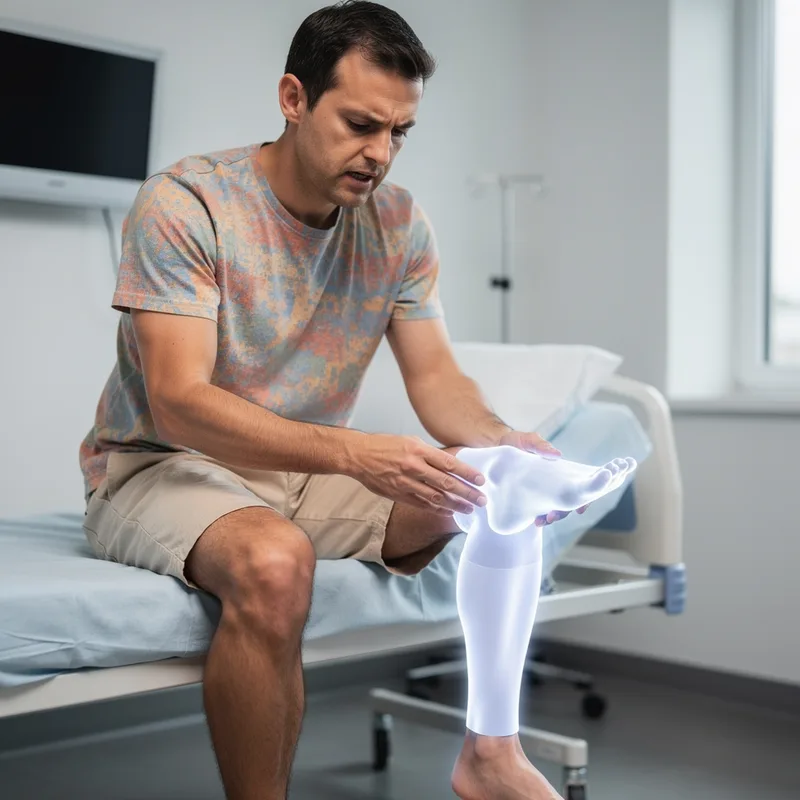
phantom limb
 3
7.0
3
7.0

- noun
- /ˈfæntəm lɪm/
- Specialized
- Many amputees experience a phantom limb, feeling as if their missing limb is still there.
- phantom limb pain
Loading YouTube…
Watch on YouTubeAnd so as he would have these patients move their intact limb to a more relaxed position, the patients would feel as if the phantom limb were relaxing.
- And so as he would have these patients move their intact limb to a more relaxed position, the patients would feel as if the phantom limb were relaxing.
- And so you may have heard of phantom limb pain in the past.
- So I get my shots in the other arm and then the right arm starts to hurt because I have all this when people lose a limb, When people lose a limb, they have phantom limb pain.
Examples
-
They come to see Roman Samiley with complaints of headaches, an old bullet wound that still burns, or phantom limb pain of an arm or leg long lost on the battlefield.
Blog text (26) -
The stories amputees told about feeling their own phantom limbs didn't apply to him.
Fiction book (2002) -
And so you may have heard of phantom limb pain in the past.
-
The feeling now is so weird, like the pain of a phantom limb.
Blog text (13) -
It's called phantom limb sensation.
-
Some control strategies of this type rely on the "phantom limb" sensation.
Academic text (1990) -
Sometimes in my sleep, I'd feel a body next to me... like an amputee feels a phantom limb.
-
And we know that because people who have amputations have phantom limbs and they can't help it.
-
He wondered if that was what a phantom limb felt like to someone who'd lost a leg.
Fiction book (1994) -
ESCS has been used for several chronic painful conditions, including back pain, phantom-limb pain, peripheral vascular disease, and severe angina.
Academic text (1996)
How Vivid
- Specialized
1
7.2

- Specialized

 1
6.1
1
6.1
- Specialized
3
7.0
Surface Forms
Morphology
The compound is largely compositional: 'phantom' (illusory) + 'limb' (appendage) yields the idea of an illusory or perceived limb, so a learner who knows both words can infer the general concept. However, the specific clinical sense—that this refers to the sensation of an amputated limb still being felt—is a specialized nuance that may not be fully predictable without prior exposure, so it is not completely transparent.
Etymology
Phantom limb uses phantom to mean a 'ghost' and limb to mean an arm or leg, so it creates the image of a ghostly body part. When someone loses an arm or leg, they may still 'feel' that missing limb, so the phrase means the sensation of a limb that is gone.