

phantasy world
- noun
- /ˈfæn.tə.si wɜrld/
- Archaic
- As a child, Sarah often retreated into her own phantasy world to escape reality.
Examples
-
He lives in a phantasy world, unable to accept the truth about his situation.
-
The novel explores a phantasy world created by the protagonist's vivid imagination.
-
She often escapes to her phantasy world when life gets tough.
-
In his phantasy world, he is a superhero.
-
As a child, Sarah often retreated into her own phantasy world to escape reality.
-
He lives in a phantasy world, unable to accept the truth about his situation.
-
The novel explores a phantasy world created by the protagonist's vivid imagination.
Synonyms

 21
4.4
21
4.4

An imagined place in your mind with magic and strange creatures
 7
5.5
7
5.5
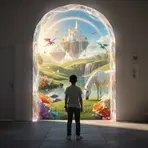
A beautiful imaginary place in stories where small magical creatures live
 3
6.1
3
6.1
An imaginary place where everything is perfect and magical
 2
6.6
2
6.6
An imagined perfect place that exists only in dreams
 1
6.3
1
6.3
A place in your mind where you imagine things

An imagined life a person makes in their mind to escape real life

Ability to imagine unreal people, places or events
Antonyms


How Imaginary
- Archaic
 7
3.8
7
3.8
Surface Forms
Morphology
The meaning 'a world that exists only in one's imagination' is directly and transparently composed from 'phantasy' (imaginative fiction) + 'world' (a realm or sum of experiences). This compositional pattern (as in the common variant 'fantasy world') is cross-linguistically familiar and would be understandable to a B1 learner who knows both constituents.
Etymology
Phantasy world comes from the idea of a whole phantasy, an imagined story, and world, a place, that a person makes inside their mind. So when someone is said to be in a phantasy world, they are thinking the imagined place is real, meaning 'a world that exists only in someone's imagination' or 'unable to accept the truth'.