
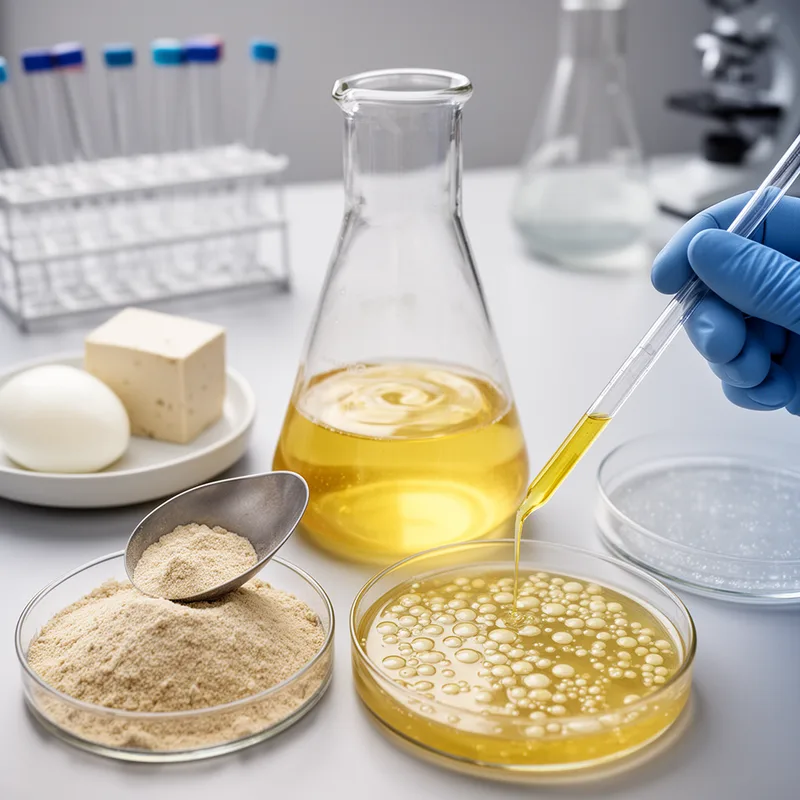
peptone


 1
9.9
- noun
- /ˈpɛpˌtoʊn/
- Specialized
- In addition to the conventional sample enrichment technique (18), we used alkaline peptone water (APW) to enrich water samples.
- peptone water
- percent peptone
- buffered peptone
Examples
-
The bacteria flourished in the nutrient-rich glucose peptone broth, indicating successful growth.
-
Inoculum was prepared by growing the selected isolates in glucose peptone broth media.
Academic text (2013) -
A 1-mL aliquot was pipetted into 9 mL of 0.1-percent peptone water, and plates were prepared according to the procedure described above.
Academic text (2005) -
After the 50-cm surface was wiped four times with a cloth, the cloth was aseptically transferred to 100 mL of 0.1-percent peptone water and neutralizer.
Academic text (2005) -
For the molds, colonies were removed directly from the agar surface and re-suspended into buffered 1 percent peptone water (Beckton, Dickinson and Co.).
Academic text (2008) -
Flasks containing glucose peptone broth were inoculated with selected isolates and incubated at 28°C for 72 hours.
Academic text (2013) -
In the laboratory, we prepared cultures using sterile water mixed with 0.1-percent peptone to support microbial research.
-
Researchers added peptone to the culture medium to enhance the growth of the yeast cells.
Synonyms
 1
8.6
A nutrient mix made from milk protein that helps bacteria grow in lab dishes
Surface Forms
Morphology
peptone = pept + one
The element 'pept-' is a non-standalone combining form and '-one' is a chemical/technical suffix, so an average B1 learner cannot derive the meaning from familiar English base words.
Etymology
Peptone comes from the Greek root pept- meaning 'to digest' and the ending -one that names some chemical substances. So peptone is a 'partly digested' protein, which is why scientists dissolve it in water to feed bacteria and other microbes in the lab.