
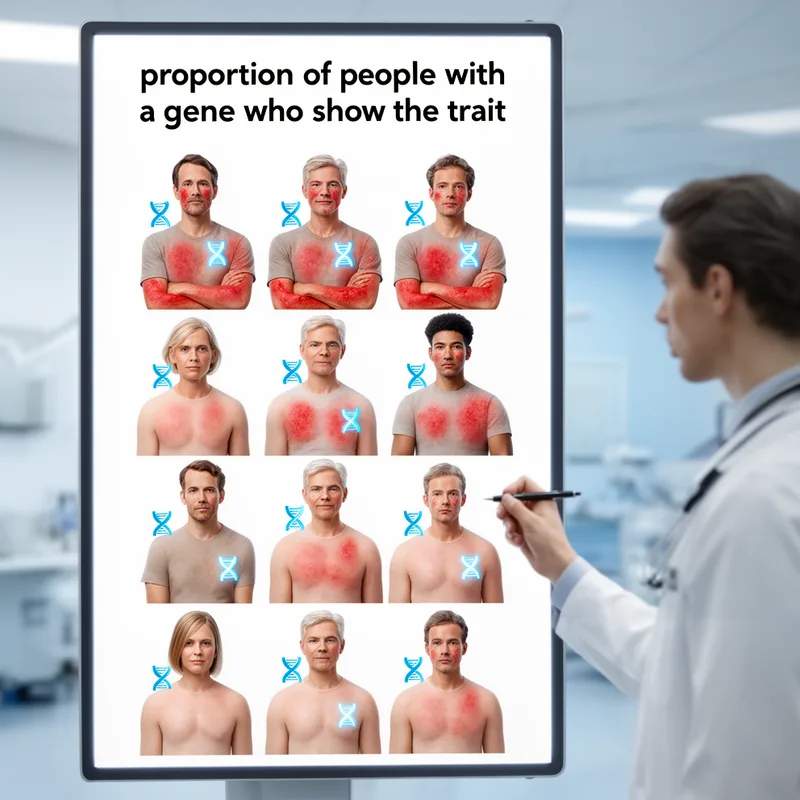
penetrance
- noun
- /ˈpɛnɪtrəns/
- Specialized
- Incomplete penetrance means not everybody who gets the genotype gets the phenotype.
- variable penetrance
Examples
-
The MUC5B variant has low penetrance and, in isolation, does not seem to be causative of idiopathic pulmonary fibrosis.
Academic text (2016) -
And then obviously you've got this problem of penetrance that you know, which is individuals with a genotype who actually express the trait.
-
Some of these deaths might be explained by inherited conditions with variable penetrance.
Academic text (2003) -
Penetrance in familial cases also increases with age.
Academic text (2004) -
It has autosomal-dominant inheritance with complete penetrance and variable expressivity.
Academic text (2004) -
Huntington's disease is an autosomal dominant disorder with high penetrance characterized by progressive chorea and dementia.
Academic text (2004) -
Isolated primary VUR is an autosomal dominant disorder with incomplete penetrance and variable expression: the genetic defect or defects are unknown.
Academic text (2000) -
But penetrance is more often than not variable in more complex genomes, largely due to genetic modifiers, stochastic effects, and minimally to some nebulous environmental inputs.
Blog text (22) -
Genetic diseases causing ion channel dysfunction, such as long QT syndrome, can have variable penetrance and can be difficult to diagnose in affected relatives of probands.
Academic text (2003) -
Penetrance describes how likely individuals with a specific genetic variant are to express the associated trait.
Surface Forms
Morphology
Etymology
Penetrance comes from the Latin penetrare, meaning 'to go into', the same root as penetrate. In genetics this idea became a way to say how often a gene's effect 'shows up' in people who have the gene, so penetrance tells us how many of the people with the gene actually show the trait.

