
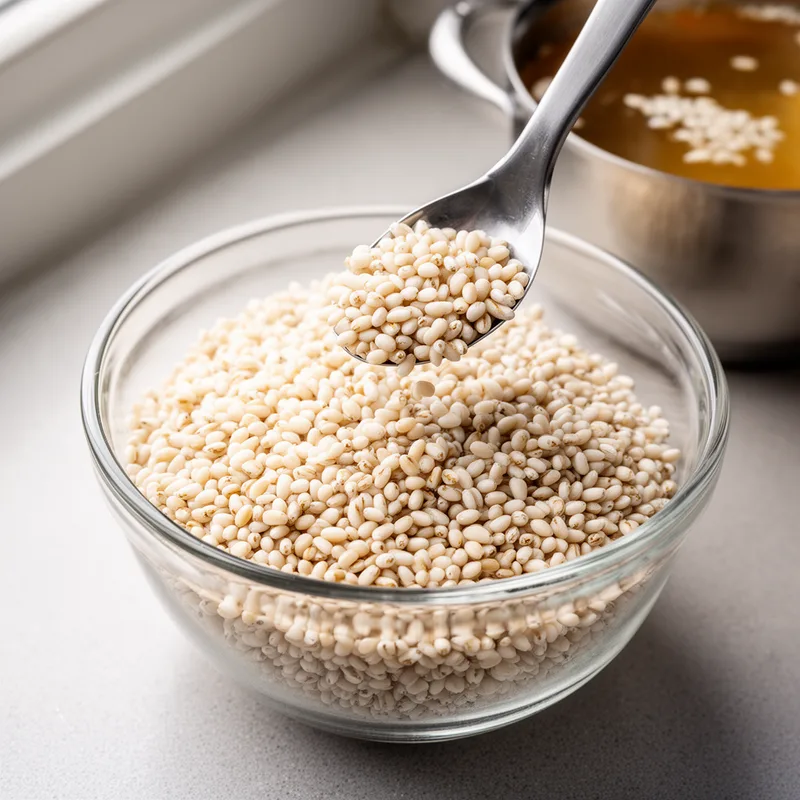
pearl barley
- noun
- /pɜrl ˈbɑrli/
- For a nutritious meal, add 1 cup of pearl barley to your soup recipe.
- 1 cup of pearl barley
- 1 cup of pearl barley
Examples
-
Two cheerful ladies in white robes and caps with reddish ringlets peeking out brought covered pots of borscht and boiled pearl barley.
Fiction book (2001) -
So things like lentils, quinoa, alga wheat, Pearl barley instead of rice.
-
We had a period when money was extremely tight and more or less existed on "bean stew," which was a mixture of pulses along with pearl barley and anything else (a variety of vegetables) that was cheap and could be made cheaper by buying in bulk.
Blog text (7) -
To make the risotto creamy, substitute pearl barley for the traditional Arborio rice.
-
In a large pot, simmer pearl barley with vegetables and herbs for a healthy side dish.
How Polished


 1
9.8
1
9.8
Surface Forms
Morphology
The noun phrase is compositional: 'pearl' modifies 'barley' to indicate barley grains that are pearly/polished, so a B1 learner who knows both words will infer it is a type of barley (used in cooking) with a smooth, rounded appearance. Cross-linguistic equivalents (e.g. French 'orge perlé', Spanish 'cebada perlada') and the straightforward modifier–noun construction make the meaning directly derivable, though the exact technical detail of removing husk and bran may be more specialized.
Etymology
The name pearl barley comes from the look of the grain: after the outer husk and bran are polished away, each barley grain becomes smooth and round like a pearl, so the term refers to barley prepared this way for cooking, often in soups and stews.