
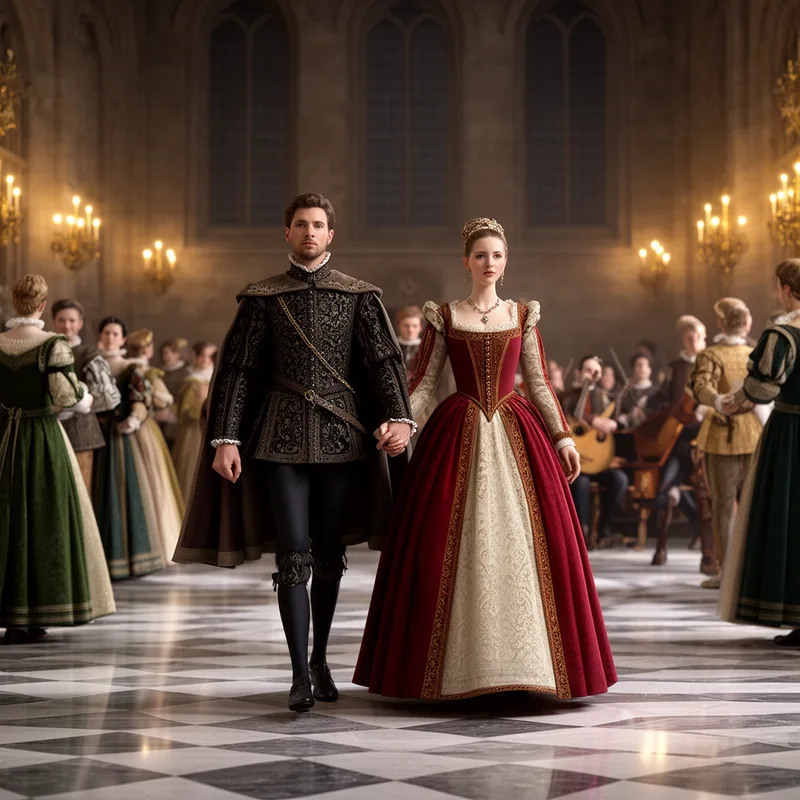
pavane


 1
9.9
1
9.9
- noun
- /pəˈvæn/
- Archaic
- The dance is a sort of abstraction of Shakespeare's Othello; the performers move through a pavane and other Renaissance dances to Henry Purcell's beautiful music.
- Ravel's Pavane
- Moor's Pavane
- Pavane for a Dead
Examples
-
The next piece was The Moor's Pavane, performed by Marcelo Gomes, Cory Stearns, Veronika Part, and Julie Kent.
Blog text (8) -
No, it was Ravel: "Pavane for a Dead Princess."
Fiction book (1996) -
'Tis a pavane.
-
"Evelyn cast her eyes over the dance floor, where a slow pavane was in progress, then thought to clarify, "We are larking about, are we not?"
Blog text (21) -
Worked on learning to play jazz, and on learning Ravel's "Pavane pour une infante défunte."
Blog text (2) -
If I had to have such a simple ground, a mere drone, then let me have a lively treble over it, a galliard or a pavane, as in Elizabethan lute duets.
Academic text (1994) -
The dancers gracefully performed a pavane in the grand ballroom, showcasing their elegant movements.
-
At the Renaissance festival, we enjoyed watching a pavane accompanied by soft lute music.
-
During the gala, a lovely pavane was played, inviting couples to dance majestically across the floor.
Synonyms
 4
9.0
4
9.0
A slow, graceful dance in three beats or the music for that dance
 1
8.9
1
8.9
A slow formal Polish dance or its music, both in groups of three beats
 1
9.9
1
9.9
A slow, formal dance or musical piece in triple time from the Baroque period
 1
9.9
1
9.9
A slow formal dance in three beats or the music for that dance

A slow formal dance from Europe in the 1500s and 1600s
A slow formal piece of music written for an old European court dance

A slow formal Spanish dance in triple time used in baroque music
How Stately
- Archaic
1
9.9
 4
9.0
4
9.0
Surface Forms
Etymology
The word pavane comes from Italian padovana, which means 'from Padua', because the dance first came from that city. A helpful way to remember it is to imagine a slow, proud parade in a royal court, with people walking like peacocks, so a pavane is a slow, stately dance.