
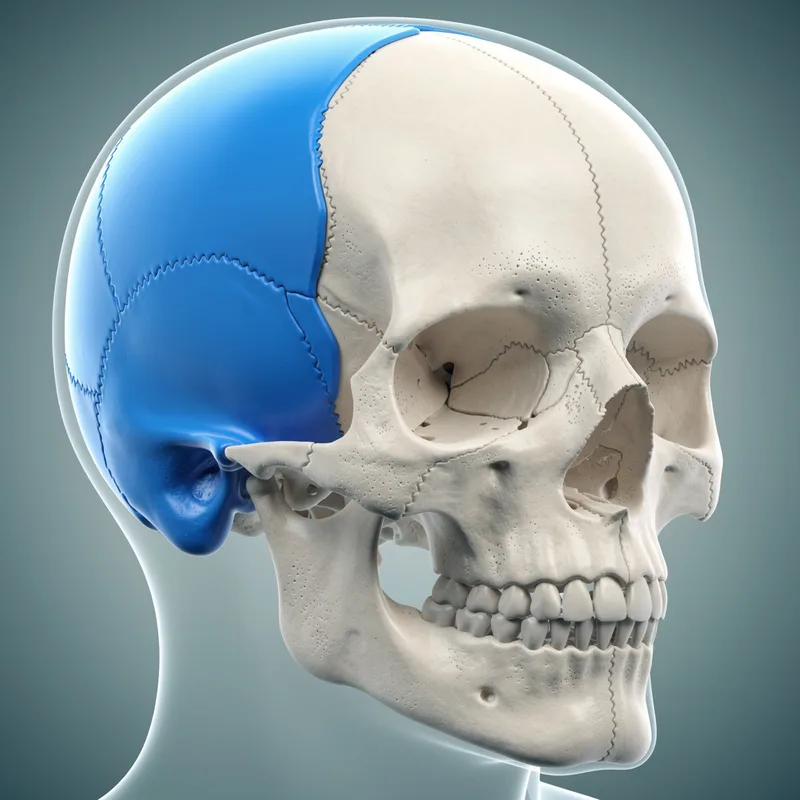
parietal bone
 2
7.4
2
7.4

- noun
- /pəˈraɪɪtəl boʊn/
- Specialized
- I was barely five-eight, reached 130 pounds only after a heavy meal, had no special talent (unlike my cousin Richie), and was prematurely bald on top, right over the parietal bone.
Examples
-
Blow came from an object roughly rectangular in shape, resulting in a depressed fracture of the parietal bone, with radiating linear fractures extending outward from the point of impact.
-
"The first is almost on the crown of the head, "reaching over to the left parietal bone.
-
"The damage to the right parietal bone and left mandible of the victim indicated that the attacker was of extraordinary physical strength."
-
The doctors examined the patient's skull to check for damage to the parietal bone.
-
An injury to the parietal bone can lead to serious complications and should be evaluated immediately.
-
During the autopsy, the pathologist noted that the parietal bone had multiple fractures.
Synonyms
 1
8.8
1
8.8
One of the two bones that form the sides and roof of the skull
Surface Forms
Morphology
The phrase is a straightforward noun phrase combining the specific modifier 'parietal' (a cranial/paired bone) with the noun 'bone', so the meaning 'the parietal bone' is directly derivable from its constituents. Although anatomical vocabulary is specialized, the compositional pattern is regular and cross-linguistically transparent, so a learner who knows both words would understand the MWE.
Etymology
Parietal bone comes from an old Latin word meaning 'wall'. The name fits because the parietal bones make the top and sides of the skull like 'walls', so the word helps you remember where they are.