
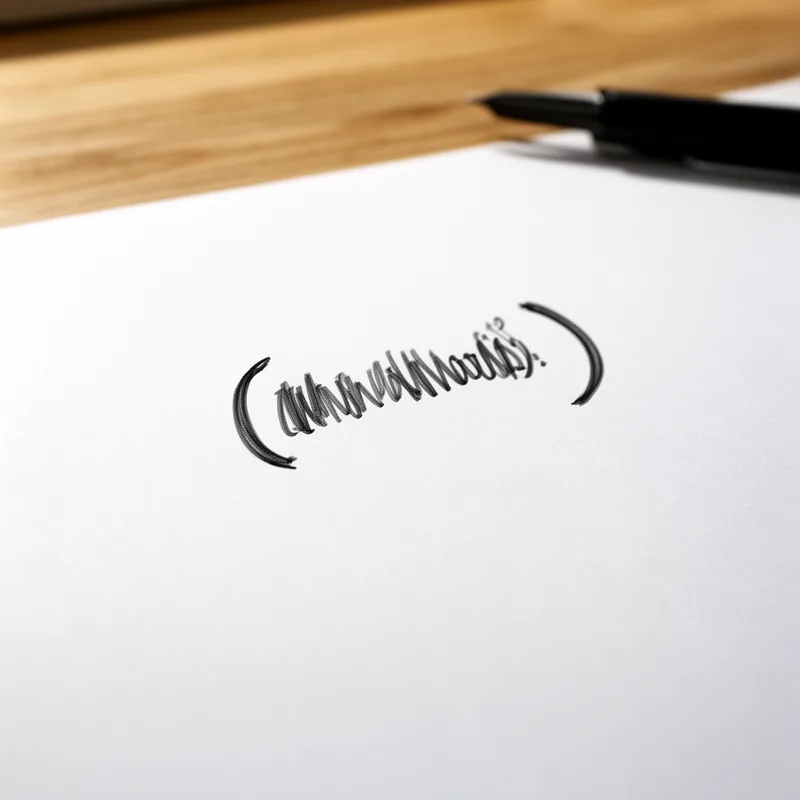
parenthesis
 2
3.4
2
3.4

- noun
- /pəˈrɛnθəsɪs/
- The author's insight was given in a parenthesis to clarify the main argument.
Loading YouTube…
Watch on YouTubeHowever, I want to put in parentheses, it's an unfixable loss.
- However, I want to put in parentheses, it's an unfixable loss.
- That is, that which is in parentheses being in contrast to that which only seems.
- That means distribute the negative sign, expand inside the parentheses.
- And he says, I'm purposely using this sports expression in parentheses.
- It's very helpful to put those parentheses there so that you get all the terms you need to get.
- My acronym was Lisp is syntactically pure, saying all you need is parentheses and atoms.
Examples
-
In the first chapter, Austen carefully situates her story in history: "at this present time," she writes, then adds in parenthesis "(the summer of 1814)" (7).
Academic text (2007) -
Note: Standard deviation in parenthesis, *: Significant at 10%, ": Significant at 5%
Academic text (2011) -
Stephen, why did you forget to put a space between a word and a parenthesis?
Blog text (5) -
OK write them in parentheses just like that.
-
The citation goes in parentheses after the final punctuation of the block quote, with no period after the parenthesis.
Academic text (2002) -
An opening parenthesis pushes the state of the turtle into a stack; a closing parenthesis pops the top of the stack and restores the turtle state.
Academic text (1997) -
You should always include the citation in parentheses to give credit to the original source.
-
The definition was placed in parentheses to provide additional context for the reader.
Synonyms
 1
1.3
1
1.3
A symbol like a period or comma that separates sentences and shows meaning
Compounds
- Specialized
A way of writing math expressions that uses the order of math signs instead of extra marks
Surface Forms
Etymology
Parenthesis comes from the Greek parts para- 'beside' and thesis 'a placing'. Think of the round marks that sit beside a sentence as a small 'place' set next to the main line to hold extra information, which is why parenthesis mark words or numbers added to a sentence.