
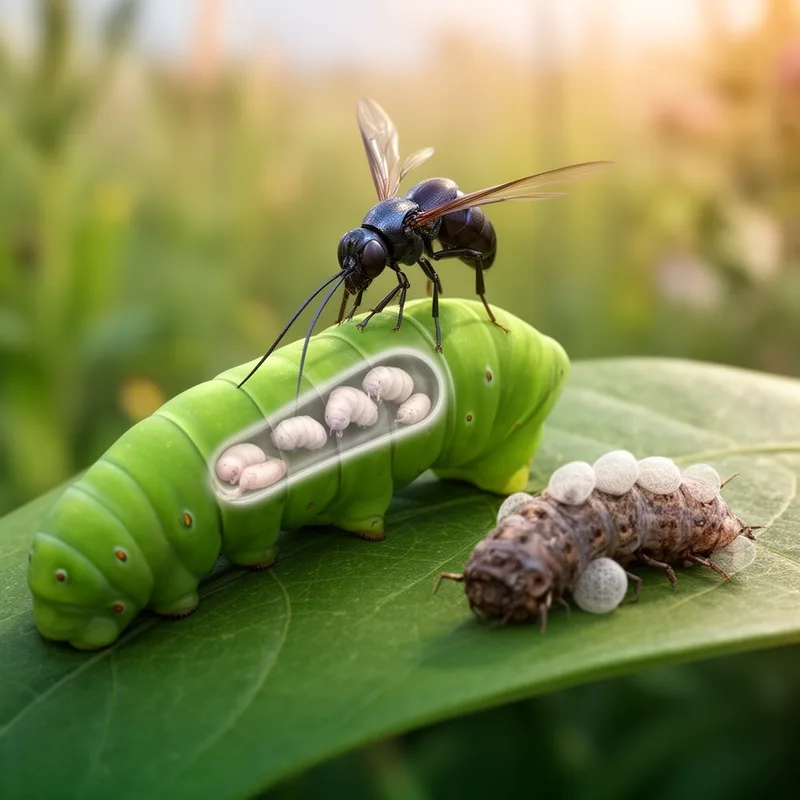
parasitoid


 1
9.9
1
9.9
- noun
- /ˈpærəˌsaɪtɔɪd/
- Specialized
- There is a very diverse and fascinating group of predators and parasitoids that will do things like eat insect eggs.
- parasitoid wasps
- hosts for parasitoids
- egg parasitoids
Examples
-
Now, ARS-sponsored studies may uncover other promising parasitoids.
Academic text (2001) -
Because they are well protected, larvae that create shelters from the leaves they feed on may be attractive hosts for parasitoids.
Academic text (2001) -
A pathogen and several species of parasitoid flies are the most effective biological control agents currently known.
Academic text (2004) -
Everyone, scientists and nonscientists alike, should open up an insect and see a parasitoid at least once in their lives.
Academic text (2002) -
Parasitoid young hatch inside the sharpshooter eggs, then proceed to feast on them.
Academic text (2001) -
In field experiments so far, we've found that parasitoids emerged from 66 to 71 percent of the eggs.
Academic text (2001) -
Among the sharpshooter's most formidable foes, for example, are egg parasitoids—insects that unabashedly lay their eggs inside sharpshooter eggs.
Academic text (2001) -
At the ARS South American Biological Control Laboratory in Hurlingham, Argentina, researchers are investigating the parasitoids that emerge from the eggs of a native South American sharpshooter, Tapajosa rubrimarginata.
Academic text (2001) -
Many parasitoids, like wasps, lay their eggs inside the bodies of their hosts, leading to the host's eventual death.
-
The larvae of certain parasitoids develop within living insects, ultimately causing the host to perish as they mature.
Antonyms
Surface Forms
Morphology
Etymology
Parasitoid is built from parasite ('one who eats at another's table') plus -oid meaning 'like', as in humanoid. So a parasitoid is an organism that is 'parasite-like' but that eventually kills its host, a meaning often used for certain wasps and their larvae.