
pantheon
 2
8.8
2
8.8

- noun
- /ˈpænθiən/
- Literature
- At the same time, Pope Boniface IV consecrated the Pantheon in Rome to the Blessed Virgin and all the martyrs.
- Pantheon built
Loading YouTube…
Watch on YouTubewhen I see something today like the Pantheon or like the Colosseum,
- when I see something today like the Pantheon or like the Colosseum,
- Next stop. Pantheon. OK, Why are we going to Pantheon? I've never been inside,
- Hey, we're going to Notre Dame today and we're going to the Pantheon today,
- So in between this and our food tour, we're going to go to the Pantheon.
- And we talked about this previously with the Pantheon, right?
Examples
-
Now, the Pantheon, which means "Temple of All Gods"... ...was originally built as a temple to all the gods of ancient Rome... ...in 27 B.C.
-
The autumnal light is pale on the vast dome of the Pantheon.
Fiction book (2001) -
Though still maintained, the pantheon is no longer the site of public ceremonies.
Academic text (2000) -
On the left is the Pantheon in Rome, one of the first concrete domes.
-
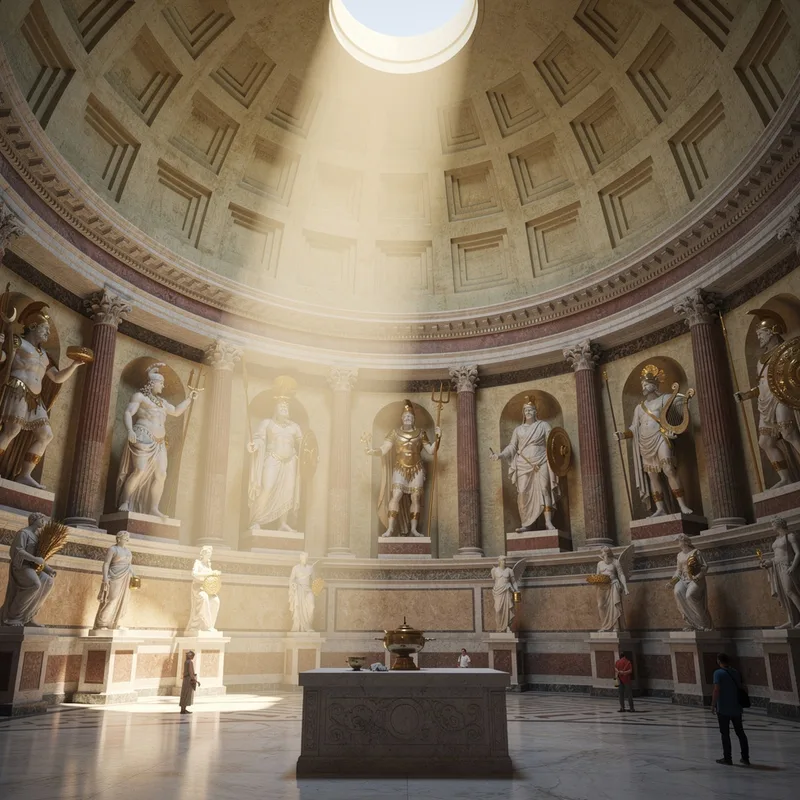
Instead, when he glanced up from his book, it was the interior of the Pantheon that met his gaze, the orifice at the center of the dome throwing against its coffered ceiling a coin of light.
Fiction book (2001) -
The ancient Romans built the Pantheon to honor all their gods, showcasing their architectural mastery.
-
Visitors to Rome often marvel at the Pantheon, a remarkable temple dedicated to all the gods of antiquity.
-
In antiquity, the Pantheon served as a significant site of worship for the diverse deities revered by the Romans.
Synonyms
 365
3.4
365
3.4
A building where people go to worship a god, for example in Hindu or ancient Greek religions
 126
4.1
126
4.1
A holy place where people go to pray and honor a saint or sacred object


 1
7.0
1
7.0
A very old place where people worship, often visited for religious reasons
How Big

Surface Forms
Morphology
Etymology
Pantheon was the name of a famous Roman temple built for pan- 'all' and theos 'god', so the word came to mean a building dedicated to 'all the gods'.