

panda
 68
1.0
68
1.0

- noun
- /ˈpændə/
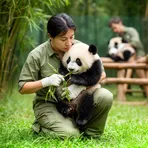
- The giant panda spends most of its day eating bamboo in the forests of China.
- giant panda
- pandas in China
- virus in pandas
Loading YouTube…
Watch on YouTubeThey're like, they're like the pandas of the animal world by now.
- They're like, they're like the pandas of the animal world by now.
- That way it doesn't look you have that panda black eye.
Examples
-
Only 1,600 wild and 300 captive giant pandas remain worldwide (11).
Academic text (2014) -
PHOTO: Munching on bamboo, a giant panda survives on a diet that may resemble that of Gigantopithecus.
Academic text (1991) -
But most people have never seen a panda in real life and probably never will.
Blog text (23) -
The competition from both humans and the giant panda may have been too much.
Academic text (1991) -
We documented infection with this virus in giant pandas in China during 2009.
Academic text (2014) -
Because bamboo is so low in nutrients, pandas must eat it constantly in order to survive.
Blog text (25) -
The zoo is noted for its trio of pandas, as well as Sumatran tigers and Asian rhinoceroses.
Academic text (2006) -
At the zoo, we watched a panda play with its cubs in their enclosure.
-
Conservation efforts are important to protect the panda, which is an endangered species.
Synonyms
 5
1.7
5
1.7
A large black and white bear from China that eats mainly bamboo
 5
1.0
5
1.0
A large black and white bear from China that eats mostly bamboo

A large black and white bear that eats bamboo and lives in Chinese mountain forests

A large black and white bear that eats bamboo

A group of bears that includes only the giant panda
Compounds



- Archaic
A small police car with black-and-white or blue-and-white markings used for patrols in Britain

Surface Forms
Etymology
The word panda probably comes from a Nepali word ponya meaning 'bamboo-eater', and people first used it for the small, reddish animal in the Himalayas. So the name helps you remember that this animal spends much of its time eating bamboo.