

giant panda
 5
1.7
5
1.7

- noun
- /ˈdʒaɪənt ˈpændə/
- The giant panda spends most of its day eating bamboo in the forests of China.
- giant pandas in China
Loading YouTube…
Watch on YouTubeThe San Diego Zoo no longer has giant pandas.
- The San Diego Zoo no longer has giant pandas.
- Both the giant panda and the red panda both independently evolved a false thumb that acts as an opposable thumb.
Examples
-
I had seen pictures of the giant pandas of Sichuan and the black gibbons of Hainan.
Fiction book (1991) -
Presented: preliminary findings from my ongoing research into the most charismatic megafauna of all: giant pandas.
Blog text (11) -
The competition from both humans and the giant panda may have been too much.
Academic text (1991) -
His main research interest is conservation of giant pandas.
Academic text (2014) -
We documented infection with this virus in giant pandas in China during 2009.
Academic text (2014) -
The San Diego Zoo follows the Chinese cultural tradition of naming the giant panda after it is 100 days old.
Blog text (5) -
Spanish researchers have discovered fossils they say could be from the oldest identified relative of the giant panda.
Blog text (16) -
Dr. Li is the deputy director at the China Conservation and Research Center for the Giant Panda, Ya'an, People's Republic of China.
Academic text (2014) -
Only 1,600 wild and 300 captive giant pandas remain worldwide (11).
Academic text (2014) -
PHOTO: Munching on bamboo, a giant panda survives on a diet that may resemble that of Gigantopithecus.
Academic text (1991)
Synonyms
 68
1.0
68
1.0
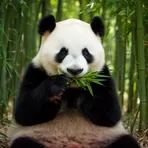
A large black-and-white bear that eats bamboo in forests of China
 5
1.0
5
1.0
A large black and white bear from China that eats mostly bamboo

A large black and white bear that eats bamboo and lives in Chinese mountain forests
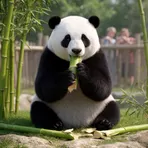
A large black and white bear that eats bamboo

A group of bears that includes only the giant panda
Surface Forms
Morphology
The meaning 'a large panda (a specific bear-like species)' is directly and transparently derived from 'giant' (very large) modifying 'panda' (the bear-like mammal). This is a straightforward adjective + noun composition found across languages, so a B1 learner who knows both words would readily understand the MWE.
Etymology
Giant panda is named for the simple picture of a very big panda: giant shows it is large and panda is the black-and-white animal famous for eating bamboo. That's why giant panda means 'a large black-and-white bear that eats bamboo'.